
Last March, the recruitment platform Talent LMS launched a new trend called “quiet cracking.” Translation: employees who maintain passable performance but suffer in silence because they don’t feel motivated or engaged in their work. We discussed the phenomenon with Emilie Charbonneau, HR advisor at Impact M10.
If we recall the original trend, “quiet quitting” described the phenomenon of employees who had decided to voluntarily disengage from their work, accomplish the bare minimum, put themselves first, and stop worrying about work. There was an almost… poetic or redemptive dimension to the phenomenon (see the TikTok video that popularized the term).
With “quiet cracking,” we’re instead looking at employees who feel stuck in their jobs; they’re unhappy, they endure, without seeing a way out. According to the Talent LMS survey, one in five employees (20%) say they feel “frequently” unhappy at work.
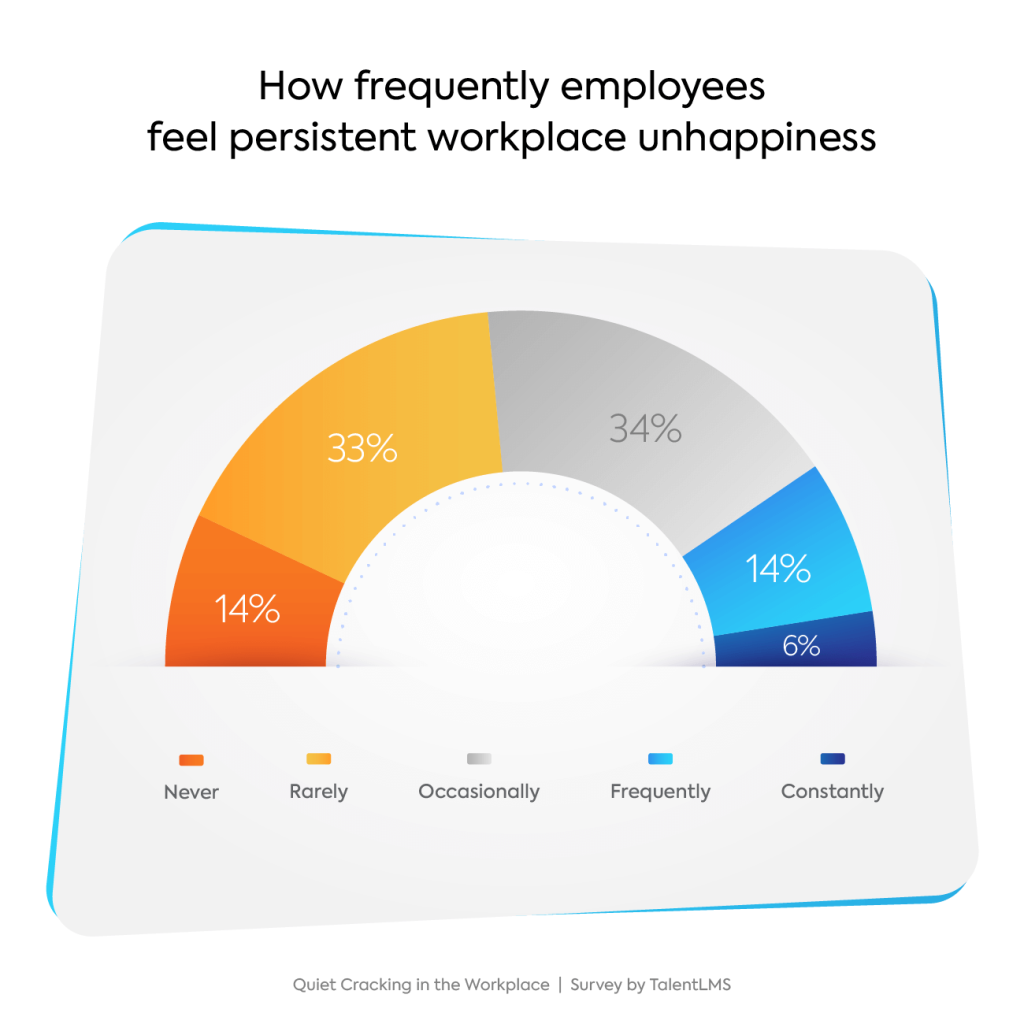
Quiet cracking is an erosion of job satisfaction that comes from within, as explained on the Talent LMS site. Unlike burnout, it doesn’t always manifest as exhaustion. Unlike quiet quitting, it doesn’t immediately show up in performance metrics. But it’s just as dangerous. Quiet cracking is that feeling of disconnection, of not feeling heard, seen, or supported for growth or learning opportunities. Over time, it leads to disengagement, declining productivity, and eventually, departure.
The causes can be varied: economic uncertainty, confusion about the employee’s future within the company, lack of opportunities for career advancement, etc.
Poorly Equipped Managers
“We live in a world that literally moves faster than what humans are capable of absorbing,” notes Emilie Charbonneau. “Everyone is under pressure from both organizational and personal factors. In a stressful situation, we can no longer communicate properly, so it generates enormous tension in the workplace. It’s distressing, but it’s predictable.”
Emilie Charbonneau observes that many managers are poorly equipped to deal with the situation.
“Given that we promote internal development, we’ll select managers internally, but without considering that they’re taking on a new role that requires new skills. These new skills aren’t technical in nature, but rather relational.”
One piece of data from the Talent LMS survey tends to prove her right: 47% of employees who feel they’re experiencing quiet cracking don’t feel heard by their manager.
“Employees have psychological needs that they seek to fulfill in their work environment. And we don’t equip managers to identify them and then adopt practices that will support employees in their psychological well-being.”
When a manager takes on a position, they can quickly realize they’re not necessarily competent in this new role. Defense mechanisms develop, and it’s at that point that attitudes or behaviors unfavorable to employee well-being can emerge.
“The famous micromanagement, the need to control everything; it’s a mechanism that stems from the manager’s stress, not from a lack of trust. These managers withdraw and freeze in the face of their responsibility. Consequence: teams don’t receive the necessary support. We can also have aggressive managers who have passive-aggressive interactions – often unconscious – that are both toxic and insidious in work environments,” she explains.
Organizational Justice as a Pillar
Beyond bad practices, the question remains: what can managers do to help their employees thrive in their organization? Emilie Charbonneau evokes the notion of organizational justice.
“The feeling of justice is one of the major pillars of well-being at work. If a manager maintains closer relationships with colleagues they get along with better, this can create a feeling of relational injustice. The employee has the impression of not having access to their manager.”
When basic psychological needs are met, an organization can also focus on the notion of “flow” to motivate its employees.
“The feeling of flow is being in your field of competence, but a notch above to feel like you’re developing, without necessarily feeling incompetent. That’s where you’ll feel motivated,” she explains.
How to do it? The manager must take an interest in the skills the employee wants to develop and give them the confidence and latitude to do so!

 training.isarta.com