
What are the best practices and strategies regarding compensation? Some answers with the traditional annual survey on salary forecasts from specialized firm Gallagher, based on responses from more than 500 organizations across the country.
An Unfavorable Context for Increases in 2026
Controlled inflation, economic slowdown, American tariffs, rising unemployment… The 2026 trend is hardly favorable for strong salary growth.
Unsurprisingly, Gallagher’s forecasts show the continued decline in average salary increases, excluding freezes: 3.1% in 2026 compared to 3.5% in 2025 and 3.8% in 2024. More than 8% of organizations have not planned any increase, a five-year high.
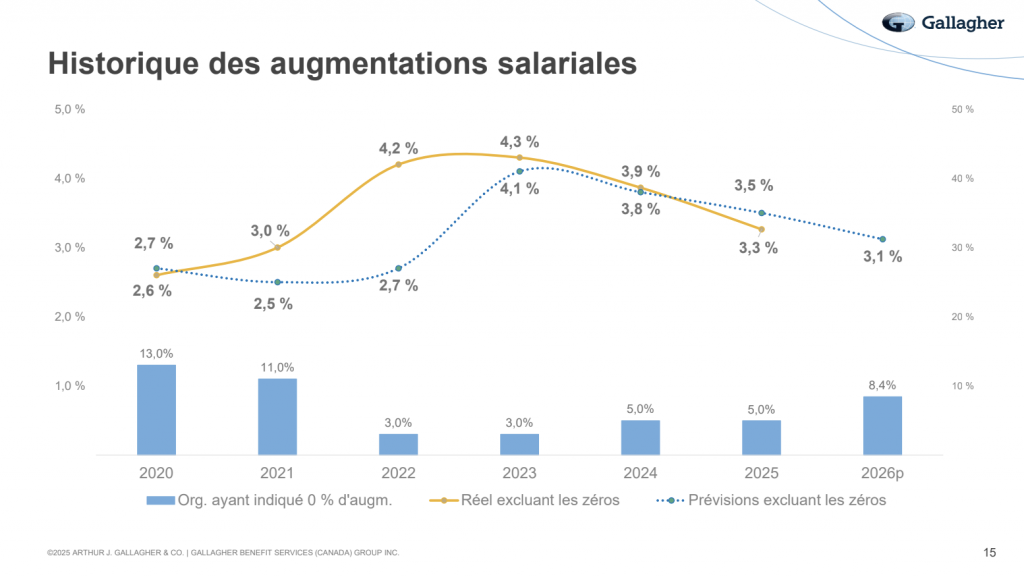
Furthermore, nearly two-thirds of participating organizations indicate that the increases planned for 2026 will be lower than the increases granted in 2025.
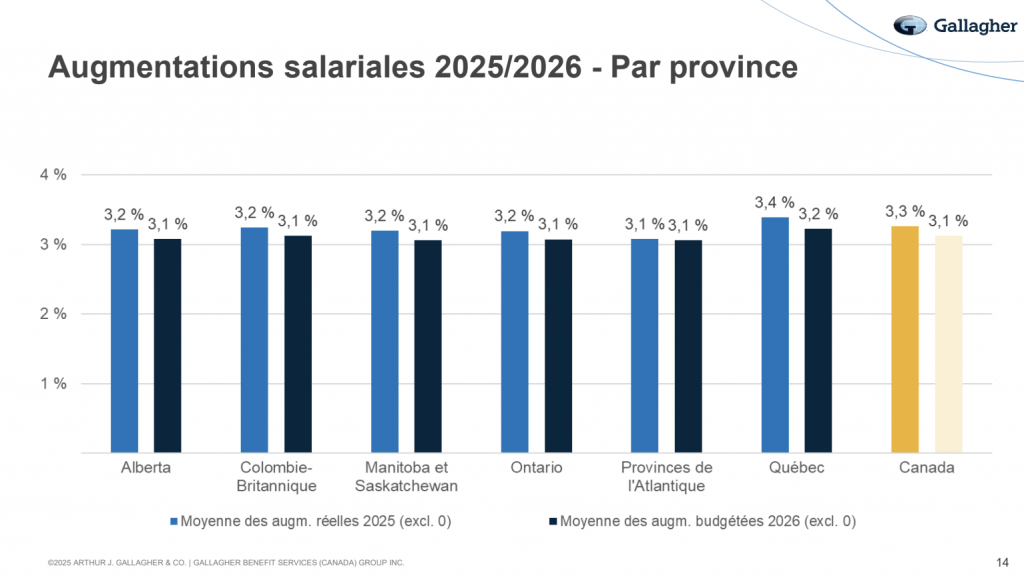
Data that is relatively consistent across the country. The increases granted in 2025 in different provinces range between 2.9% and 3.4%, while the increases planned for 2026 range between 2.9% and 3.2%. Quebec has the highest actual and forecast increases (3.4% for 2025 and 3.2% for 2026).
However, some gaps appear between sectors. Thus, legal services (3.7%), real estate (3.5%), and professional services (3.4%) prove to be the most generous, unlike education services (2.9%), municipalities (2.9%), or foundations (2.7%).
Noting that, as last year, one-third (32%) of organizations have an additional budget dedicated to managing special cases, such as high-potential or fast-track employees.
Less Pressure on the Job Market
Given the reduction in job vacancies, challenges related to attraction and retention continue to decrease this year (62% in 2024, 54% in 2025, and 50% in 2026). At the same time, 20% of organizations plan not to index their salary structure in 2026.
“This could mean that organizations feel less pressure from a compensation standpoint to attract and retain employees, or that they consider their structure sufficiently competitive,” notes the report.
Another signal illustrating this trend: non-monetary programs (training, mentoring, development, special projects, career management programs) are less used this year (30%) than in 2024 (42%) and 2025 (42%). The same is true for signing or hiring bonuses, retention bonuses, and to a lesser extent, off-scale salaries.
Salary Transparency Gains Ground
The report also takes stock of the legislative context regarding salary transparency, particularly in light of laws passed in British Columbia and Ontario. In the latter province, only 12% of organizations apply no transparency.
Beyond transparency, the manager’s role is essential in communicating compensation to employees. Good news: 84% of organizations indicated that their managers have resources to support them in this process.
However, these resources are often limited to support from the human resources department (77%) or organizational documents and policies (68%). On the other hand, only 27% of organizations report offering specific training on compensation to their managers.

 training.isarta.com