
Is generative AI really delivering on its productivity promises in the workplace? One might doubt it after reading a recent study published in Harvard Business Review that has just created a new word likely to get people talking: “workslop.” When AI gives the appearance of doing good work when in reality… everything needs to be redone!
There’s a paradox here. On one hand, not a day goes by without technology companies announcing something new while investing billions in AI. Pressing employees worldwide to adopt these technologies, or risk being left behind.
On the other hand, the promised revolution is slow to generate concrete impacts. Last July, an MIT study (based on a limited sample of 300 public initiatives) made headlines by announcing that 95% of companies see no return on investment from their generative AI investments. A phenomenon dubbed the “generative AI gap,” between the massive adoption of tools like ChatGPT… and their concrete impact on business results.
Illusion of Progress
A research team from BetterUp Labs, a coaching platform, in collaboration with the Stanford Social Media Lab, has just added fuel to the fire by unveiling a survey on “Workslop.” A neologism that could be defined as AI-generated professional content that appears to be good work but actually lacks substance to be truly useful!
Polished slides, long reports, extremely condensed summaries, code without context… The forms may vary but the conclusion remains the same: an illusion of progress that, instead of saving time, forces colleagues to (re)do the necessary thinking work.
According to their survey of 1,150 American employees, 40% of professionals indicate they have received this “sloppy work” in the past month! In terms of volume, this represents more than 15% of content received.
Generally, the phenomenon occurs between peers (40%) although managers indicate receiving it from their teams (18%) – or vice versa in 16% of cases. While “workslop” affects all sectors, the report notes it is predominant in professional or technology services.
An Erosion of Trust
Certainly, concerns about technology’s impact on our cognitive abilities aren’t new. Back in 2006, The Atlantic journalist Nicolas Carr was already asking if Google was making us stupid.
Except that workslop this time uses machines to offload cognitive work onto another human being. “When colleagues receive ‘workslop,’ they are often forced to take on the burden of having to decode the content and deduce the missing or erroneous context,” the researchers write.
Instead of saving time, AI… wastes it! On average, the study estimates that employees spend 2 hours fixing problems caused by this fragmentary “work.”
“For an organization of 10,000 workers, given the estimated prevalence of workslop (41%), this represents more than $9 million per year in lost productivity,” the researchers calculate.
Not to mention the social costs: annoyance, loss of trust, and deterioration of relationships with colleagues. One-third of people (32%) who received “workslop” report being less likely to want to work with the sender again in the future!
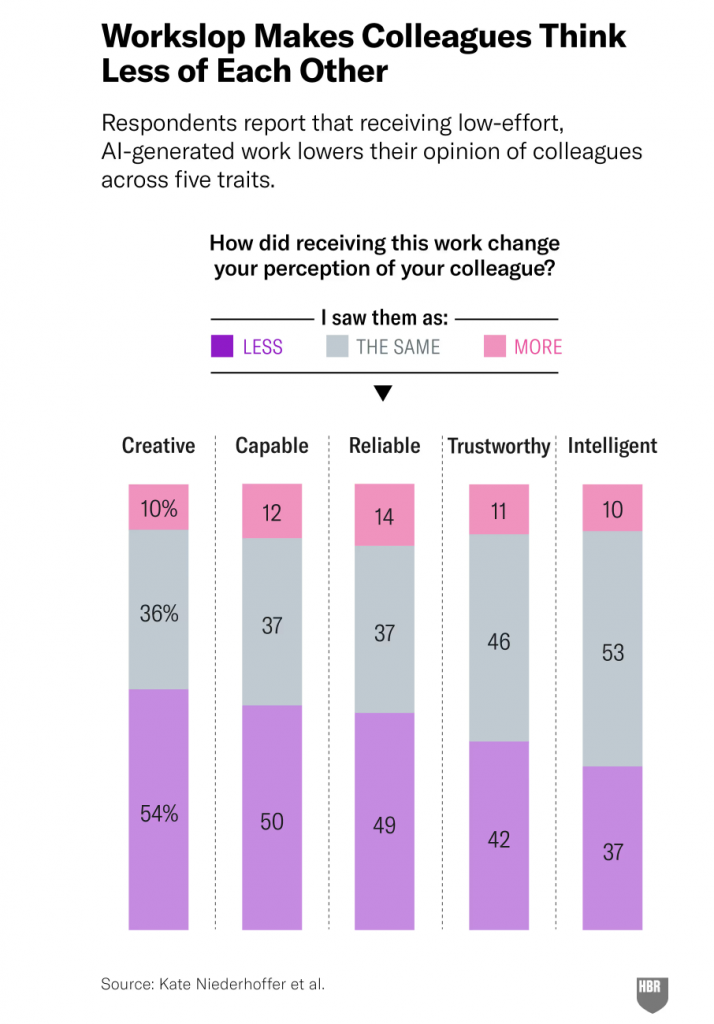
The solution? Don’t be “passengers” but “pilots” of AI according to the terminology used in the article. That means knowing how to discern when generative AI can be adapted to a defined task, then properly using the tools in question with relevant instructions.
“In 2025, collaboration between colleagues must include products that use AI in our workflows. These tools should not be a way to dodge responsibility. This is a new critical frontier in terms of organizational citizenship behaviors. This is what will make the difference between companies that maximize AI’s value and those that use it without benefit,” the authors conclude.
Something to remain optimistic about!

 training.isarta.com
  training.isarta.com
  training.isarta.com