
Are productivity gains from AI a miracle or a mirage? It’s a dilemma many organizations are facing today, as they observe rising individual performance among their employees… with no measurable effect on their overall results. Let’s try to understand why.
The anecdote is telling. A few weeks ago, Uber’s Chief Technology Officer revealed that the company had spent its entire annual AI budget… in just four months. The platform had recently built an internal dashboard ranking employees by their AI usage.
Beyond the questionable nature of that strategy, what followed is even more puzzling. In a podcast interview, Uber’s Chief Operating Officer admitted that, despite this substantial investment, he had seen no tangible effect at the company level.
That link doesn’t exist yet,” he said. “Maybe implicitly we’re shipping more features, but it’s very hard to connect any of those statistics to saying: ‘OK, we’re actually producing about 25% more useful features for consumers.'”
Solow’s Paradox
According to a recent PricewaterhouseCoopers survey of nearly 4,500 executives across 95 countries, 12% of companies report that AI has helped increase revenue and reduce costs. Yet at the same time, the majority (56%) say they are seeing… no benefit at all.
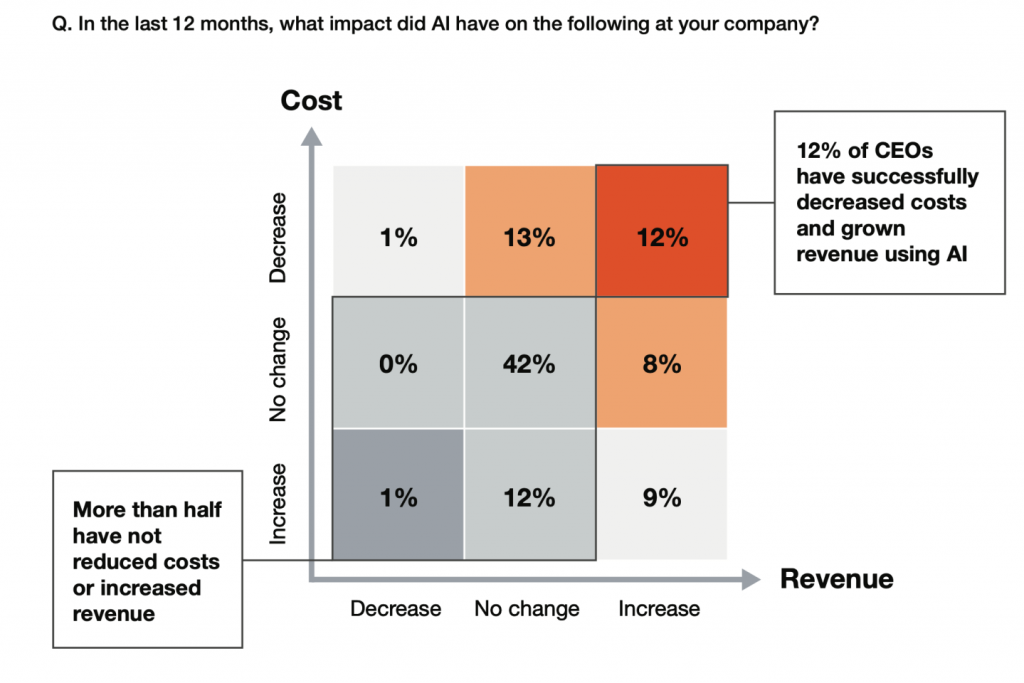
A paradox that directly echoes the one formulated by American economist and Nobel laureate Robert Solow in 1987: “You can see the computer age everywhere except in the productivity statistics.”
AI is indeed omnipresent in conversations, conferences, marketing pitches, and social media posts… but productivity gains remain modest for now, or at least difficult to measure at the organizational level.
Let’s explore a few possible explanations.
Innovations Arriving Too Fast to Embed in Internal Processes
In a recent op-ed, strategy consultant Yves Cavarec points to the necessary complementarity between AI and human judgment.
Models often generate impressive results, but they always require business judgment, validation, contextualization, and final accountability from people,” he writes.
The problem is that this process takes time, both in terms of team learning and integration into company workflows. And the current pace of technological and model turnover is preventing that maturation from happening.
Projects often never reach industrial scale: by the time a company has configured, validated, and deployed a solution, a major new version is already available, making the previous work partially obsolete,” he concludes.
For him, AI is above all a governance issue: the priority should be measuring business indicators, not just technical ones. In other words, think about internal processes before thinking about LLM models.
The Spread of “AI Slop”
Another possible reason: the proliferation of AI-generated outputs that look polished but are, in reality, fairly low quality. In other words, “AI slop.”
A Workday study found that nearly 40% of time saved through AI is subsequently lost to rework: correcting errors, verifying outputs, and so on. A few months earlier, another survey found that 40% of employees had received “AI slop” at work in the past month.
The consequence: if one person completes their work faster but offloads extra effort onto their colleagues in the process, productivity gains will be hard to detect in the aggregate.
Where Are the Productivity Gains Being Reinvested?
Finally, one more factor worth mentioning. According to a study by two researchers at the University of California, Berkeley, which we covered last March, the adoption of generative AI is leading less to a reduction in employee workload than to an intensification of work.
More work should, in theory, translate into better company results. But on one hand, is this increase in tasks sustainable over the long term, and won’t it simply lead to higher rates of burnout?
On the other hand, are the new tasks being performed, thanks to time freed up by AI, actually the most important ones for the organization?
These are questions organizations will need to answer if they want to turn AI into a genuine driver of performance.

 training.isarta.com