
Should you publish daily on LinkedIn or stick to just a few scattered posts to avoid saturating your audience? This is one of the traditional big questions that plague social media managers and marketing directors. To provide some answers, social media management software publisher Buffer analyzed, through its data scientist Julian Winternheimer, over 2 million posts from 94,000 LinkedIn accounts. Here are the four key takeaways.
1. You Can Never Publish Too Much!
First lesson that may surprise: unlike other networks, LinkedIn’s algorithm doesn’t penalize very frequent posting. On the contrary: publishing more often improves performance!
Buffer analyzed posts from the same accounts during high-intensity weeks and calmer weeks. Results:
- 2 to 5 posts per week: +1,182 impressions per post and +0.23% engagement rate (the percentage of people who interacted among those who saw the post)
- 6 to 10 posts per week: +5,001 impressions and +0.76% engagement rate
- More than 11 posts per week: +16,946 impressions per post and three times more engagement
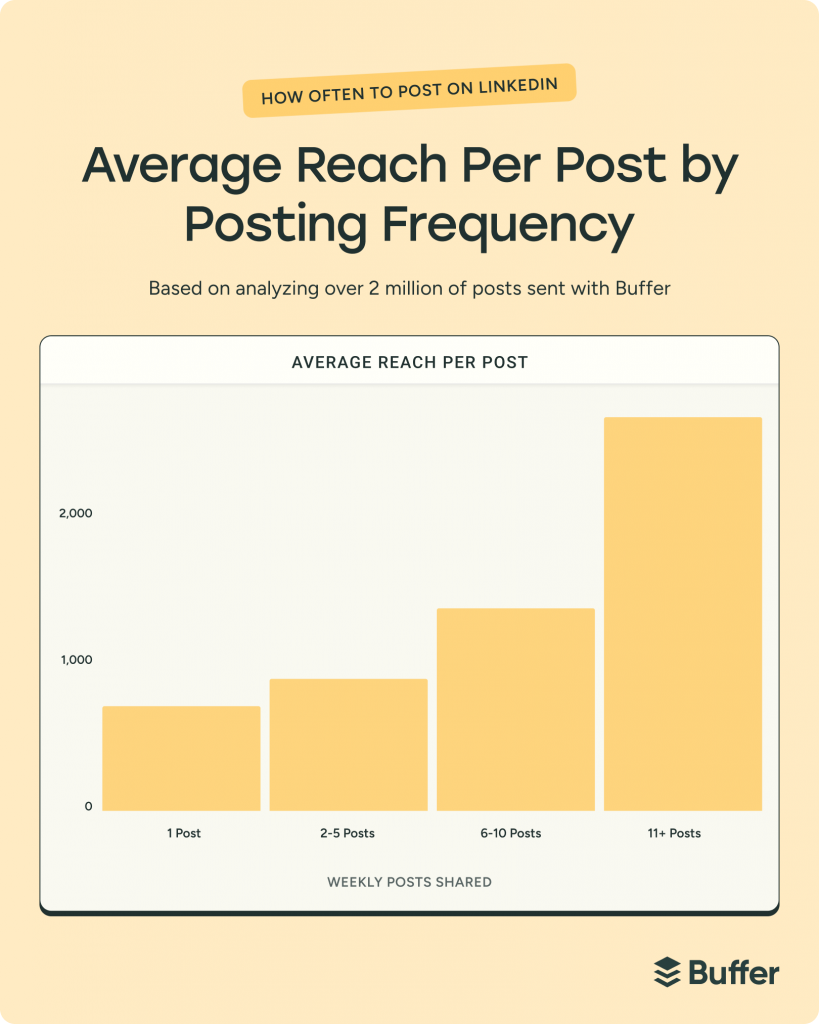
Clearly, whether we like it or not, LinkedIn rewards abundance.
“LinkedIn doesn’t ‘limit’ your reach and doesn’t penalize you if you post often. On the contrary, it reinforces your visibility by putting more of your content in front of more people. The myth of ‘posting too often’ probably comes from other platforms, where algorithms can reduce visibility with high frequency. On LinkedIn, it’s the opposite — the more you publish, the more distribution opportunities you create,” the report summarizes.
However, this finding is nuanced by Francis Jette, digital strategist and trainer at Isarta:
“In these calculations, we often forget to highlight the impact on how people in our network perceive us and their long-term fatigue from always seeing posts on too many topics…”
2. The Right Balance: 2 to 5 Posts Per Week
Obviously, not everyone can—or wants to!—post more than twice a day! Julian Winternheimer puts this in perspective:
“You should post as often as possible… as long as quality remains consistent! Low-quality content published frequently won’t yield good results.”
According to him, the right frequency to maintain a good level of quality is just under one post per day:
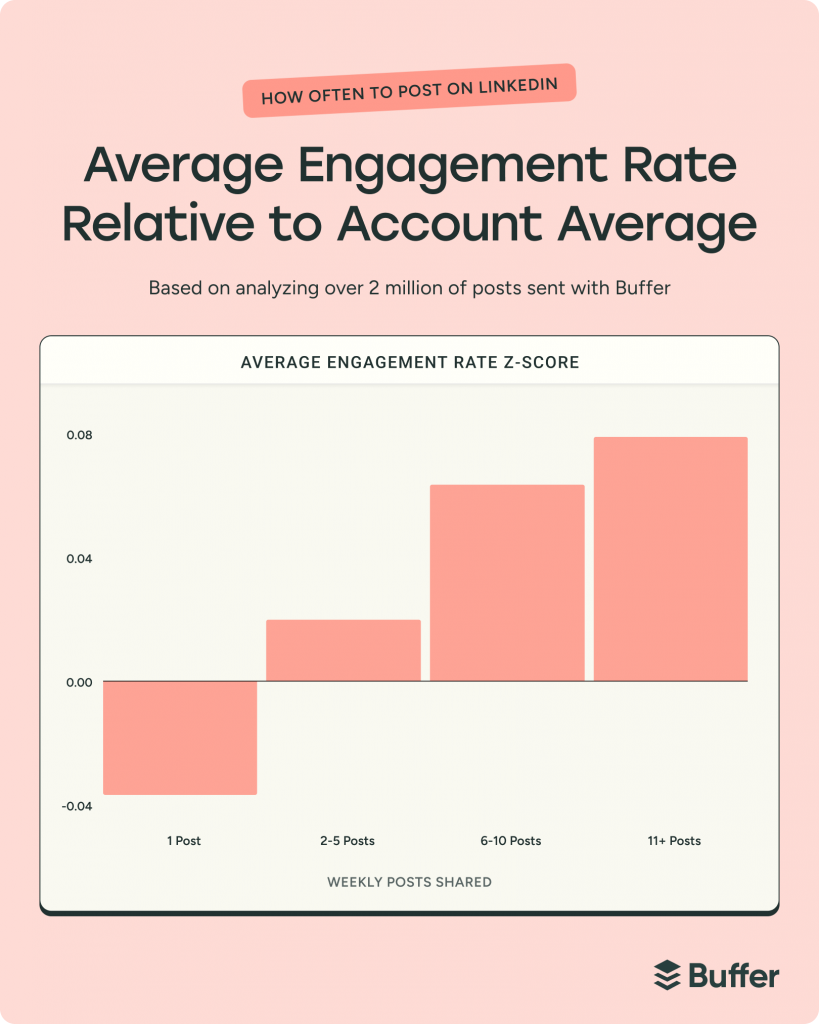
“By crossing the threshold of 2 to 5 weekly posts, the algorithm considers the account as truly active and this leads to notable gains in engagement. It starts rewarding your content by offering you better distribution.”
Conversely, posting just once a week remains insufficient to trigger real momentum, resulting in lower average performance.
3. Small or Large Accounts: Same Battle
A frequent objection heard: these results would only be valid for large accounts (which generate more reach and engagement and have the capacity to post more often). False, the study responds.
Using statistical methods, Buffer isolated the effect of audience size… and proved that the phenomenon is universal.
- Small accounts progress proportionally as much as large ones when they start increasing posting frequency from one to 2-5 posts per week.
- Large accounts generate more impressions in absolute value, but the growth dynamic per post is identical.
“Frequency is a lever that every creator can activate. The algorithm values activity and regularity, not just account size. Whether you have 500 or 50,000 followers, increasing your posting frequency improves your posts’ performance relative to your own average,” the report summarizes.
4. Carousels Remain the Best Format
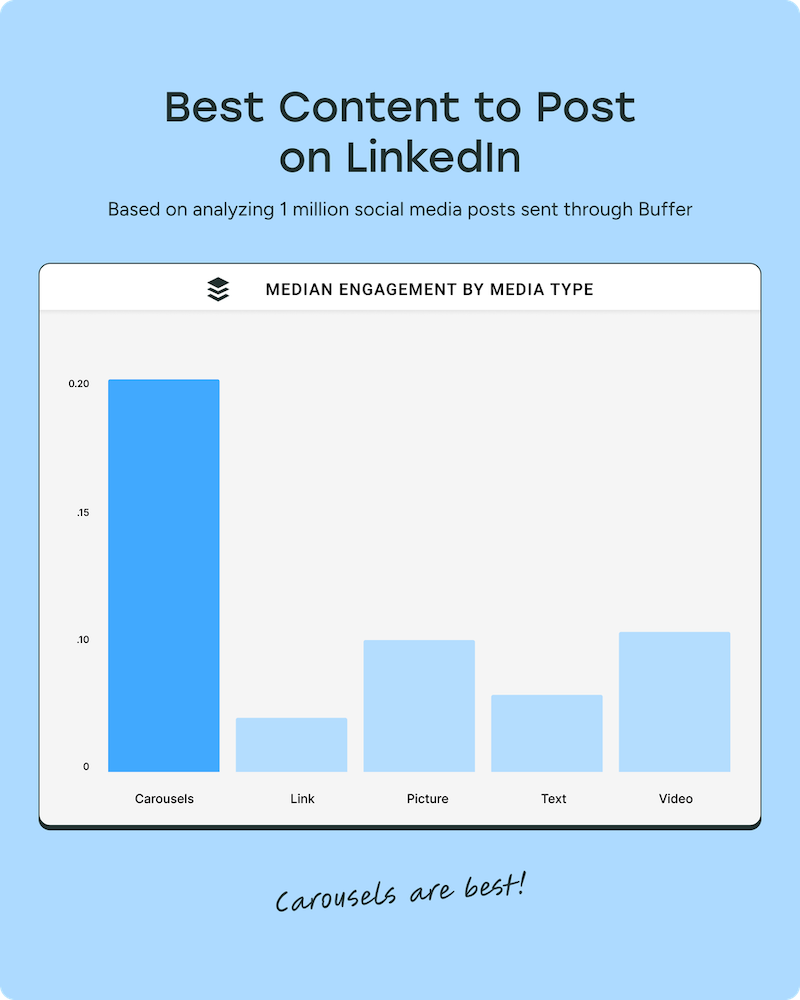
The last point is the least surprising since it’s already supported by several other similar studies: format matters as much as frequency… and carousels (scrollable PDF documents) are by far those that achieve the best results (+300% engagement compared to videos or 600% compared to text).
Let’s remember, however, that they generally take the longest to create. Everything has its price!
Links, unsurprisingly, represent the least engaging formats… because the algorithm doesn’t want users to leave the platform. Hence the usual technique of many content creators to publish them in post comments instead (which additionally has the merit of making users click to learn more).
In summary, publishing more never hurts, but regularity and quality take precedence over overproduction. Instead of saturating your audience with posts without real added value, it’s also worth noting that LinkedIn recently introduced impressions for comments.
“This means that relevant and engaging comments now function as micro-posts, visible to people outside your own network. This radically changes the game for staying visible without having to create more original posts,” the report concludes.