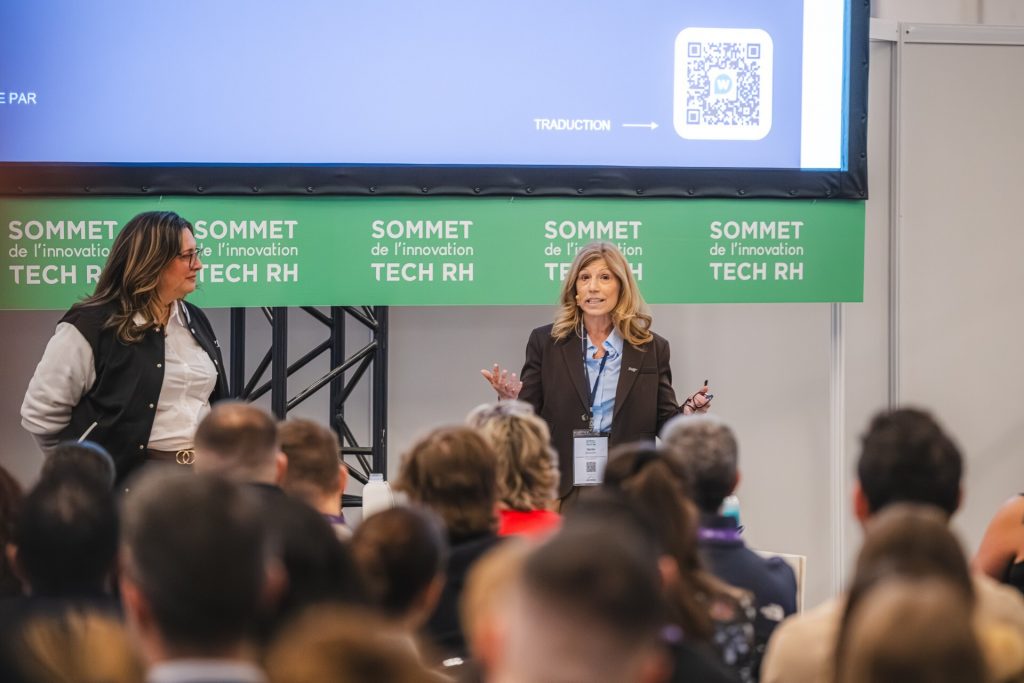
Over the past year, conferences, summits, and reflection days on AI have multiplied at a feverish pace… HR professionals, for their part, gathered on February 12 for the 2nd edition of the Tech HR Innovation Summit at the Palais des congrès in Montreal. A recap of an event that showed technology in HR could ignite passions, but also exhaustion.
The technology conferences held within the glass-enclosed space built in the center of the exhibition hall all hit the mark. Large companies like Bell, PwC, GardaWorld, and Olymel were all very generous in unveiling their HR digital transformation projects—with details on measures, setbacks, and adjustments made along the way. All of this in front of a dense and enthusiastic crowd.
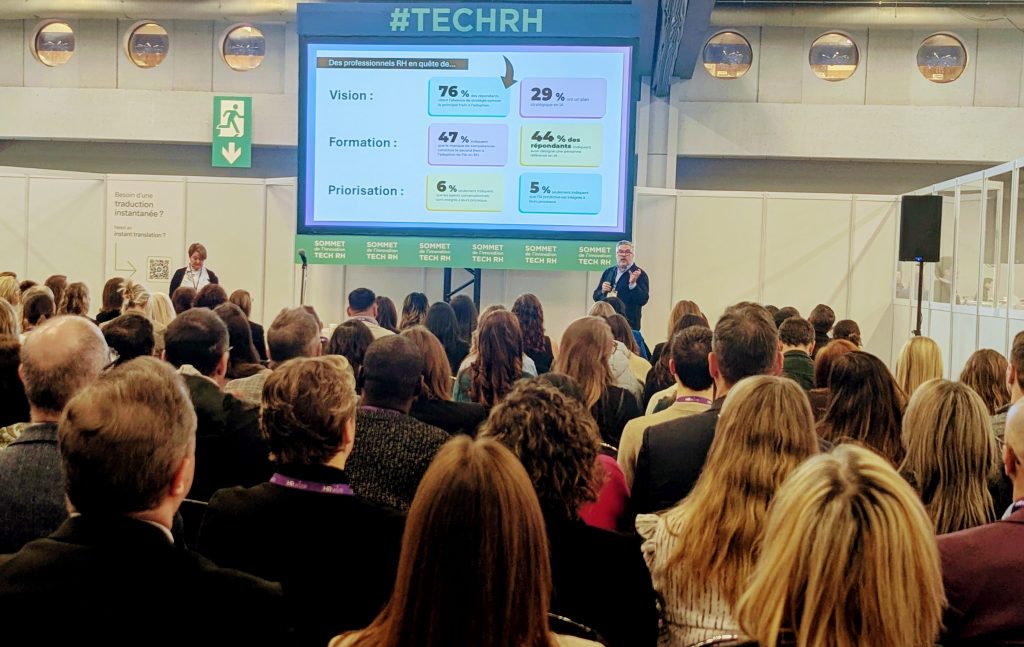
Early in the day, organizer Jean-Baptiste Audrerie set the tone for digital transformation within the HR function by unveiling Canada’s first AI in HR Barometer. Over the past year, there has been much unstructured use of ChatGPT (80% of HR professionals occasionally use generative AI and 91% see it as an opportunity to increase productivity) for very few “structured” innovation projects touching on strategic aspects of organizations (only 33% of companies have AI governance, 29% have an AI strategic plan, 16% are planning AI investments, and 49% of HR professionals believe they are “lagging behind” in AI adoption compared to other departments).
“We’re facing the challenge of moving from individual AI to organizational AI—integrated, secure, that captures value in your organizations and is attached to your processes, systems, and data,” analyzes Jean-Baptiste Audrerie.
More broadly, the arrival of generative AI seems to have completely eclipsed projects related to HR analytics. Against the 80% using ChatGPT, 40% of HR professionals openly admit not knowing about predictive AI, while only 5% integrate it into their processes.
“Making data speak, doing forward-looking analysis—that’s the neglected stepchild of AI,” laments Jean-Baptiste Audrerie. “Yet that’s exactly where we need to go.”
The HR Function as Bearer of Ethical Responsibility
Beyond the straightforward adoption of technologies in HR or elsewhere, there is an increasingly clear role emerging for the HR function. And this role, the function seems ready to assume.
HR professionals are increasingly called upon regarding the ethical dimension of AI. There’s a whole series of issues related to bias, data quality, and information sharing. According to our survey, HR says it is the protector of equity and neutrality. And we know that trustworthy AI is a real issue in a candidate selection process,” notes Nexa RH’s co-founder.
Jean-Baptiste Audrerie points to the fact that 61% of HR departments say they play an “active” role in protecting personal information.
Mathieu Boulard-Monarque, Director of Payroll and HR Digital Transformation at Bell, conveyed a similar message during the conference “Modernizing the Employee Experience: How to Add an Engagement Layer Without Changing Your Systems?”
“As for artificial intelligence, I think HR plays a key role in the company,” he asserts. “[We educate] people in the company to shed light on how to use AI, when to use it, through responsible AI use practices.”
Bell seems intent on standing out in a context where, generally speaking, HR professionals simply follow the parade.
“Today, AI uses in HR concentrate where the puck already is: recruitment, administration, compliance,” wrote Martin Mathe in the introduction to the HR Barometer. “The gains are real, but limited. We’re using transformative technology to do the same thing as before, just a bit faster. As Wayne Gretzky said, advantage is created not where the puck is, but where it’s going to be. When it comes to AI, too many HR professionals are still stuck in the past.”
Let’s hope the HR function rediscovers its inspiration… during the course of 2026!

 training.isarta.com