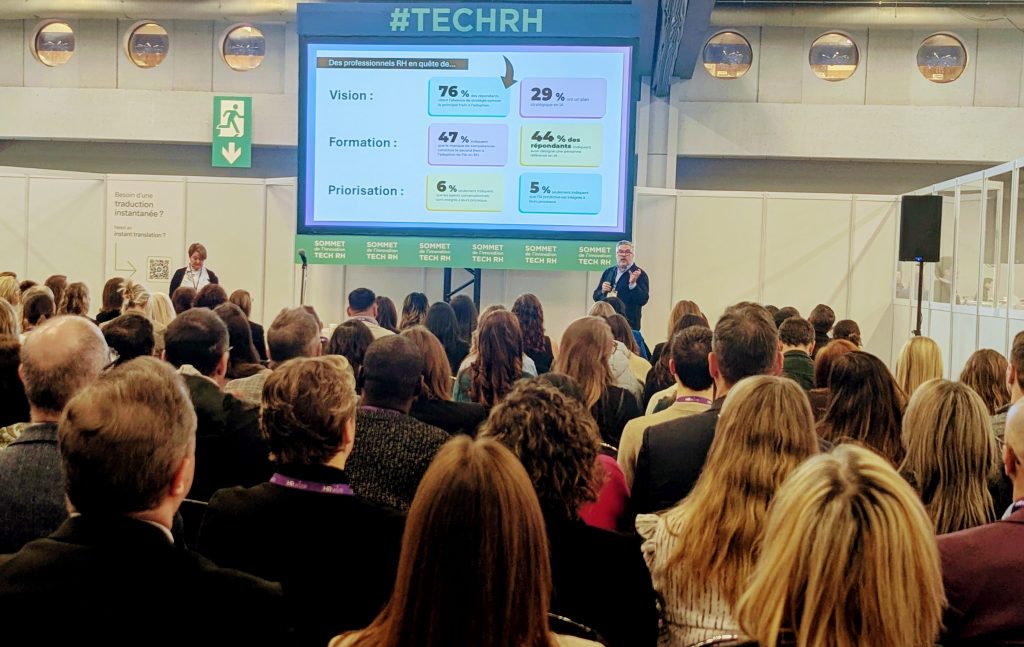
The Nexa RH firm unveiled, as an introduction to the Tech HR Innovation Summit it organized on February 12 at the Palais des congrès in Montreal, Canada’s first AI in HR Barometer. An opportunity to reveal the gap that exists between perceived AI opportunity… and its still secondary place in strategies. Analysis of 6 key findings.
1- An Optimism That Doesn’t Yet Translate Into Action
First observation and an important one: HR professionals are very positive about AI’s contributions to their profession and their organization. 91% see it as an opportunity—only 3% as a threat.
Yet this enthusiasm is not yet reflected in operational and strategic practices: 29% of organizations have an AI strategic plan, 33% have formal governance, and 23% have dedicated funding.
This prompted Marc-André Nataf, CEO of Cegid, to state:
“This gap between enthusiasm and actual capacity is the main tension today and sets the agenda for 2026-2027: structuring the architecture, investment, and skills to transform intention into operational value. Rather than waiting for perfect conditions, HR must adopt a pragmatic and iterative approach.”
He added, by way of concrete illustration:
“Launching low-risk, high-impact pilot projects allows you to quickly demonstrate value. Priority should be given to simple and measurable use cases: CV screening automation, conversational HR FAQ, automation of administrative tasks.”
2- Recruitment, Administrative Management, and Training as Primary Use Cases
Let’s get practical. Unsurprisingly, among the various HR functions, recruitment concentrates the most developed uses: 75% of HR professionals affirm that this is where they have experienced productivity gains, ahead of administrative management (70%) and training (55%). Other areas (time and payroll management, career management and mobility, compensation, prevention and safety…) do not exceed 25%.
Looking more closely, however, less than one in four organizations doesn’t use AI in recruitment (24%), while this proportion jumps to 43% for training and 56% for administrative management.
Drilling deeper into recruitment use cases, we find that respondents primarily use AI for job description writing (52%), pre-screening question suggestions (46%), or interview note-taking and summarization (34%).
3- Training and Identification of “Champions” as Primary Measures for Developing AI Internally
One of the major levers for deploying an AI culture within an organization through the HR function? Training. Over the past three years, only one in five organizations has implemented no program in this area.
The others have primarily deployed training on understanding and using AI (58%), prompt techniques (37%), or tool usage (32%).
Furthermore, among the celebrated measures are the designation of a dedicated person to lead AI (44%), an internal team trained in AI (34%), or the implementation of AI governance (33%). Figures that, as we saw earlier, remain relatively low compared to the promises offered.
Interestingly, HR professionals themselves feel they are lagging behind other functions… even though they feel they are average when it comes to personal AI in their daily lives. Even in their professional use cases!
4- Development Through Trial and Error Due to Lack of Clear Strategy
The main barrier identified by 76% of respondents is the absence of a clear strategy. This lack of vision leads to opportunistic, fragmented adoption that is difficult to pilot.
The second obstacle is the deficit of internal skills (47%), followed by budget constraints (43%). Paradoxically, return on investment appears only in second-to-last position among concerns (19%), suggesting that the problem is not economic justification but rather execution capacity.
This difficulty is moreover widely recognized: 64% of professionals believe that deploying AI tools in HR is quite or very difficult—particularly in large enterprises where complex governance slows adoption.
5- Risks Under Close Scrutiny
HR professionals demonstrate acute awareness of risks, chief among which are confidentiality and protection of personal data (91% concern). Algorithmic bias in recruitment, career management, or evaluation also concerns 76% of respondents.
Moreover, HR professionals believe they have a major role to play in protecting personal information within the organization. An ethical responsibility highlighted by Jean-Baptiste Audrerie, co-founder of Nexa RH, in his remarks.
6- The HR Function, Transformed but Not So Much?
One final paradox emerges: while 64% of respondents believe AI has already transformed their practice, only 30% consider their profession will be “largely transformed” within three to five years—the lowest proportion of all functions studied (management, production, sales…).
This relative serenity may stem from the belief that people will always prefer to work with humans. But according to the experts interviewed in the study, this conviction could prove dangerous. AI is not just a technological revolution—it is a profoundly human transformation that will place HR either at the heart of change or on its margins.
For 2026, 40% of organizations plan to increase their HR technology budgets. The acceleration is underway. Even if it remains timid.
Methodology:
The national survey was conducted from October 1 to November 30, 2025, in French and English, among 336 Canadian HR decision-makers.