The digital industry that revolves around online search has not experienced profound upheavals since the advent and dominance of Google. A stability called into question with the rise of generative AI?
“It’s the first time in over twenty years.” Last April, Eddy Cue, Apple’s head of services, revealed that the number of queries made from Safari’s search bar has declined. His explanation: internet users are using artificial intelligences like ChatGPT or Perplexity instead of Google, Apple’s browser’s default search engine.
Statements that must obviously be put in the context of Google’s trial in the United States, where the Mountain View company is accused of abusing its dominant position in online search: it notably paid Apple $20 billion to be its default search engine.
AI, Now a “Credible” Alternative
Nevertheless, Eddy Cue’s remarks reveal the potential upheaval represented by the meteoric rise of conversational robots in this market on which Google built its empire. The Apple executive even drives the point home by announcing that they are “actively” studying the integration of AI search on Safari, considering that new alternatives have now become credible.
On the defensive, Google refutes: “We continue to observe overall query growth,” the American giant hastened to respond. Specifying that Generation Z internet users (18 to 24 years old) were still those conducting the most searches.
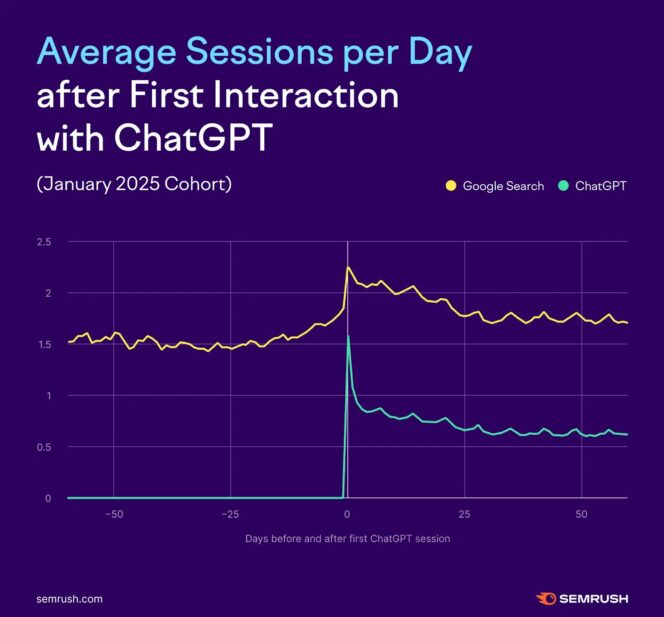
A finding that seems corroborated by a recent study from the SEO optimization solution Semrush. According to the latter, AI would not replace Google… but would instead increase the number of searches!
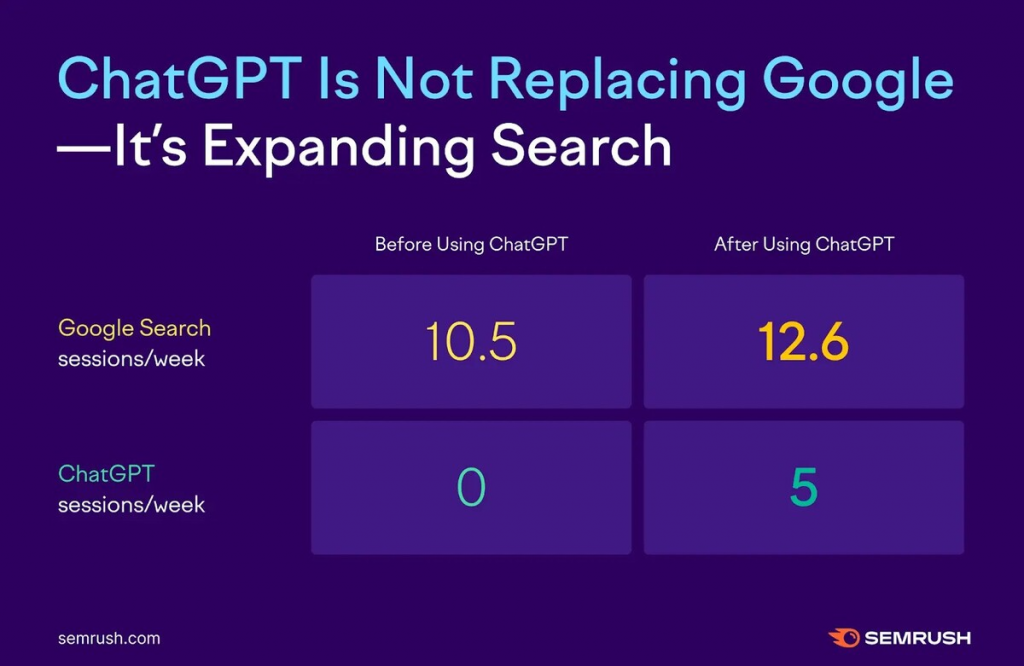
By scrutinizing 260 billion pieces of browsing data between January 2024 and June 2025 between a control group that does not use ChatGPT and other cohorts that started using it during the analysis period, it turns out that Google search usage increases slightly when internet users use ChatGPT. As if AI usage prompted more online searching.
Publishers the Real Victims?
Nevertheless, Google unveiled its own AI response feature in May 2024, AI Overview, clearly sensing the growing scale of this new way of searching for information online.
Even if this means potentially cannibalizing its lucrative sponsored links market. And a potential earthquake for an entire ecosystem, from SEO players to online marketing professionals (SEA) to media and content publishers.
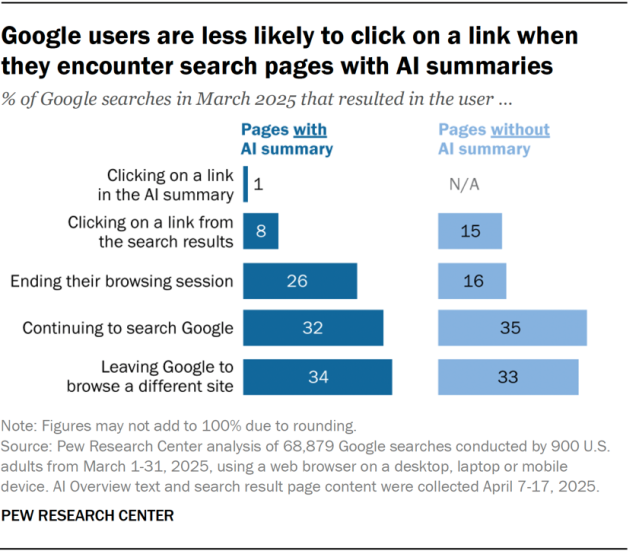
According to a survey by the Pew Research Center conducted among 900 Americans (and 69,000 queries), internet users who have access to an AI summary of the answer to their query are less likely to click on other links afterward (8% click-through rate versus 15% without AI summary).
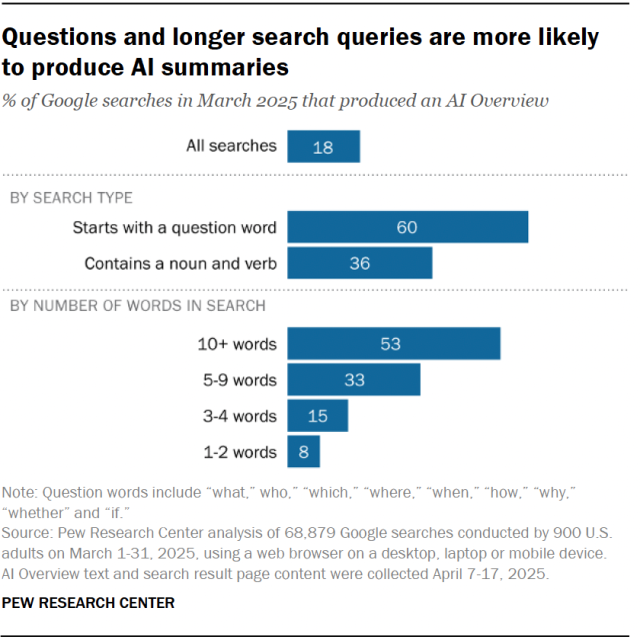
Another interesting finding: longer queries, which use complete sentences or begin with a question, are most likely to get an answer through AI Overview on Google.
Enough to worry traditional web players who fear seeing part of their traffic diverted from their content, thus dangerously threatening their business model. A concern put into perspective by Google, which claims that, on the contrary, artificial intelligence has had no impact on the total number of organic clicks sent to sites. Better yet: the “average quality of clicks” has improved (defined by users who stay longer on destination links).
According to the American company, habits are changing with the appearance of new behaviors. On one hand, internet users would conduct more searches by asking more questions than before. On the other hand, they diversify their sources and increasingly favor “authentic voices,” particularly through podcasts, videos, or detailed analyses.
The battle, however, is only just beginning. In early August, the AI-powered “answer engine” Perplexity made an offer ($34.5 billion!) to buy Chrome from Google. Just days after OpenAI (the owner of ChatGPT) announced its intention to launch its own browser.
Certainly a major upheaval to come for communications and marketing professionals!

 training.isarta.com