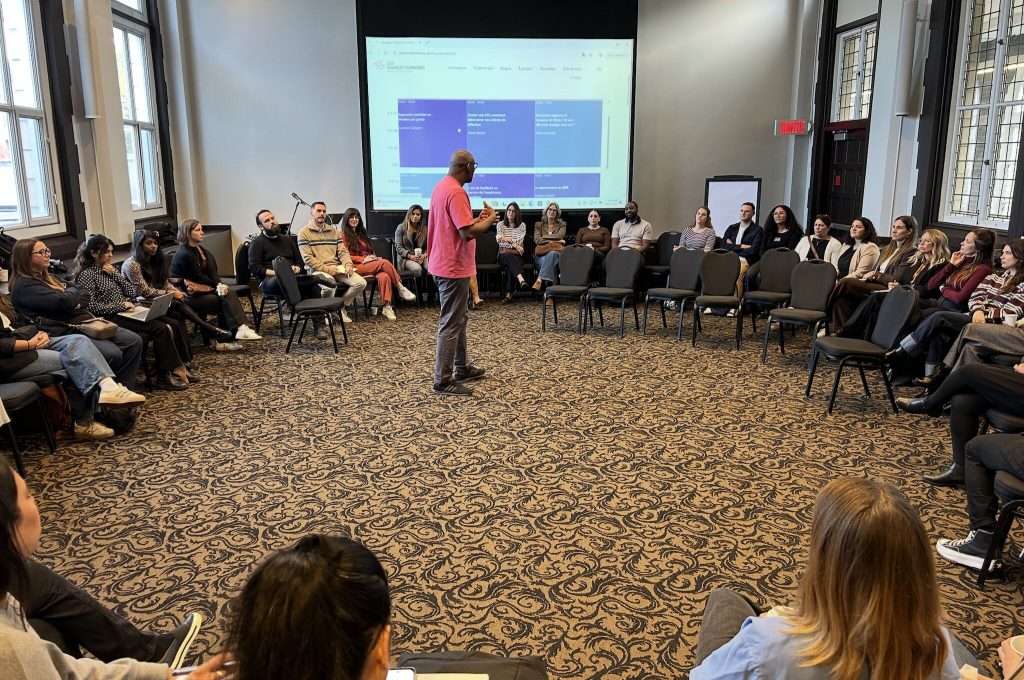
At its best, the Trumontreal unconference, held on October 22, is a laboratory for revisiting preconceived ideas about the recruiting profession. During the discussion titled “Candidate Approach – Selling Your Position,” Laurent Cebarec deconstructed the widespread notion that a recruiter’s success depends on personalizing their message to candidates. He counters it with the concept of relevance.
At the first workshop of the day, participants seemed momentarily bogged down in the question of how many words an optimal LinkedIn candidate follow-up should contain:
- Should you include all the job details?
- Should you show candidates that you know their background and skills?
- Should you highlight the transferable skills they could leverage in their new role? etc.
More broadly, the underlying question was how much should you personalize your message or not? To which coach and recruiter Laurent Cebarec responded:
“Personally, I’m much more focused on influence and manipulation, even neuroscience. I’m primarily interested in creating a conversation—I want to be able to exchange, so I want to create a connection. I don’t do personalization, I do relevance. I ask myself why I’m speaking to my contact.”
In keeping with the spirit of L’École du recrutement in France, he refuses to refer to his prospects as “candidates.”
“Candidate is not a profession,” he summarizes. “You’re trying to find someone who will fit your job and who will want to work with you and the company. There are no candidates. We’re in relationships with people.”
To “create a conversation” with potential hires, the recruiter looks for possible anchors to pique the curiosity of his target while maintaining engagement throughout an outreach message.
In the audience, a recruiter echoed the same sentiment:
“For me, we’re not selling a job description, we’re not selling a job, we’re selling a conversation. Come chat with me. So you de-risk the conversation as much as possible. It’ll take five minutes, and worst case, if you’re not interested, we’ll have made a connection.”
The participant added that he doesn’t have time to write 30 “personalized” messages to different people every day.
“I ask myself: what’s going to excite this person? They don’t care if I know their entire educational background. What they want to know is whether they can be successful with us.”
On the team he leads, the recruiter doesn’t look at message length. His recruiters simply need to focus on authenticity.
Cold Calling: A Direct Line to Authenticity
Rather than over-personalizing messages on LinkedIn, an old strategy resurfaced in the discussion: picking up the phone and calling the candidate.
“I don’t leave messages, I just call people,” shared one recruiter. “Honestly, it works really well. In a year, I maybe have one person I apologize to for coming on too strong. Otherwise, people are super receptive and open to discussion.”
Another recruiter built on this approach:
“When we talk about authenticity, human contact, building trust, being able to sense if the person is interested in the position, a call makes sense. By talking to the candidate, we’ll know more quickly if there’s a fit or not.”
The discussion facilitator, Laurent Cebarec, views this strategy favorably:
“Picking up the phone breaks a pattern, it creates a spark.”
During an exchange with a candidate, he also emphasizes the mutual value each party can bring to the conversation.
“When I do a 45-minute interview with a potential candidate, I always reserve 20 minutes at the end to give them feedback; you’ve given me your time, I’m going to give you my time too,” explained coach and recruiter Laurent Cebarec.
In the audience, a recruiter summarized her approach for starting a conversation with a candidate:
“I often start my call with: I sent you a lot of information, you responded positively to my request. Do you have any questions? What caught your attention? What do you need to know more about to continue the conversation?”
Now that’s a remarkably effective way to stay “relevant” in a candidate’s eyes!

 training.isarta.com