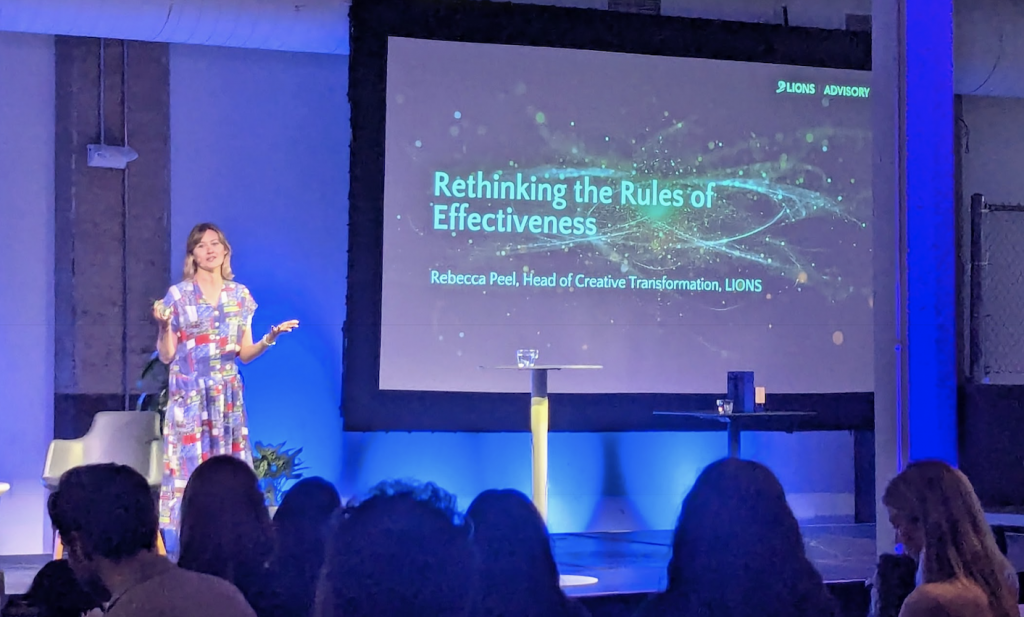
Under the subdued lighting of the Le Bungalow event space, housed in the historic red-brick building on Richarson Street, Rebecca Peel (LIONS Advisory) delivered a state-of-the-industry address on advertising to A2C members gathered at Journée Idéa 2026 on June 11. Here are her key takeaways.
1. Awareness vs. Conversion: No Need to Pit Them Against Each Other
Last year, major brands pulled back from their brand-building strategies to focus primarily on moving buyers through the conversion funnel (see the Nike case). Today, they’re paying the price for it, says the Head of Creative Transformation at Lions, citing the Multiplier Effect study.
This study was created to help settle the relentless debate between performance marketing and brand building,” explains Rebecca Peel. “The main conclusion is that one is not more effective than the other. Awareness is actually a multiplier of performance.”
There’s no need to “choose” between the two strategies — they’re complementary.
A balanced approach to advertising serves two functions. It activates the 5% of people who are currently in the market and ready to buy. Importantly, it also creates a memory anchor among the 95% who aren’t in the market yet. Because when they are ready, yours is the brand they need to think of.”
2. Distinctiveness vs. Repetition: Complementary Once Again
In June 2025, the Creative Dividend study identified three essential ingredients for effective advertising: emotion, distinctiveness (the “wow” factor), and consistency. At first glance, distinctiveness and consistency might seem like opposites. They’re not.
You need to bet on consistency, even if, on the other hand, you’re probably hearing your platform partners shouting at you that they need fresh creative. According to their data, attention drops off after four exposures. But two things can be true at the same time,” says Rebecca Peel.
As with her first point, the Head of Creative Transformation explains that constancy and repetition act as an amplifier when the time comes for a brand to launch a campaign that breaks new ground.
3. To Have an Impact, Ads Need to Actually Be “Seen”
During her presentation, Rebecca Peel referenced researcher Karen Nelson-Field’s study “THE EYE-WATERING COST OF DULL MEDIA,” which examined how effectively today’s advertisers are actually reaching their audiences. The findings were striking: 75% of digital inventory receives no active attention whatsoever.
What’s the point of great creative if no one sees it?” asks Rebecca Peel. “Great advertising will never make up for a poor choice of format.”
Food for thought.

 training.isarta.com