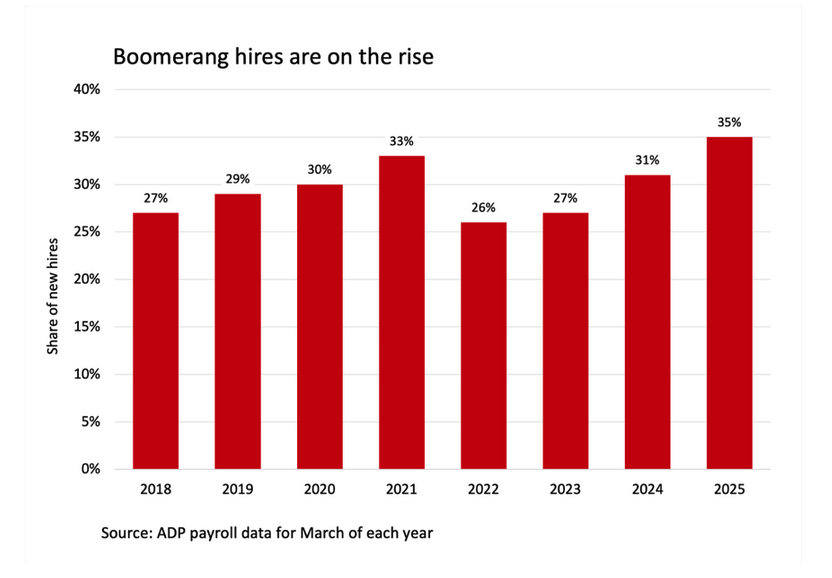
In a recent study, payroll management company ADP showed that hiring “boomerang employees” (those who left and then returned to their company) has been steadily increasing for 3 years, rising from 26% of new hires in 2022 to 35% in 2025. We wanted to better understand this phenomenon by speaking with professionals who chose to return to the fold.
In 2020, Julien-Pierre Boisvert accepted a job offer from his former employer AppDirect, where he had been a technical recruiter from 2016 to 2017. He returned as Senior Director of Talent Acquisition. Why this return to the fold?
“At the time I left, the company’s leadership was very centralized in the United States. However, with the globalization of talent and the pandemic, AppDirect – like many other companies – began building its leadership outside the usual major centers, like San Francisco or New York. An AppDirect recruiter contacted me and offered me a director position,” he explains.
Julien-Pierre Boisvert didn’t hesitate to say yes. “I loved the company and its culture,” he enthuses. As Director of Recruitment, he now knows both sides of the coin, since the company has a boomerang employee recruitment program. The Montreal-based director explains its virtues for both employee and employer:
“First, the employee already knows the product, the clients, the structure and the company culture. They don’t need to be ‘re-educated.’ Onboarding happens much more quickly. Second, it completely changes the employee’s perspective. When things get tougher, they’re less likely to think ‘the grass is greener elsewhere.’ They’ve already left once. They came back with full knowledge of the situation.”
To convince a former employee to return to the fold, Julien-Pierre Boisvert sees one essential ingredient to put in place: conducting good exit interviews to understand the reasons that led someone to leave. Then, it’s important to be very transparent in the recruitment approach.
“When we approach a former employee, we start by talking about current challenges, and especially, what the main differences are since their departure. We’ll address all the friction points, then we’ll explain how we see their reintegration into the organization in their new role,” he lists.
Returning to the Fold, “A Turning Point in My Career”
When Frenchman Gaudérique Traub arrived in Quebec in 2018, he had a brief first work experience as a consultant at the Quebec Young Chambers of Commerce Association (RJCCQ). A “junior position with multiple responsibilities, often subordinate and with a modest salary,” he describes.
“I left this position because I was looking to acquire skills closer to my public relations profession within a larger structure. An opportunity arose within the City of Montreal’s economic development service, to contribute to the development of the PME MTL network. This position allowed me to develop more structuring experience and expand my network,” he continues.
A few years later, he had the opportunity to return to RJCCQ, gaining some stripes along the way.
“I came back with enriched experience: a better understanding of public issues, a solid network of contacts in economic and political circles, as well as a stronger professional grounding. I was offered a senior position as Director of Public Affairs and Government Relations, with strategic latitude and adjusted salary recognition.”
Gaudérique Traub sees several virtues in returning to a former employer.
“Coming back to an organization was a turning point in my career. This decision allowed me to reach a professional milestone while bringing the organization a fresh perspective, an expanded network, and a refined understanding of its values and internal workings. This return wasn’t simply going backward. It came with a change in mindset: I no longer saw myself just as an employee, but as a strategic collaborator. And I was perceived as such. This recognition established a more balanced relationship with the employer based on reciprocity and trust.”
More broadly, Gaudérique Traub is convinced that boomerang employees enrich internal practices. Moreover, their prior knowledge of the company facilitates their reintegration. And their often more proactive presence positions them within teams as credible and inspiring peers to their colleagues.
“This dynamic also invites us to review how we manage departures,” he adds. “An employee who leaves today can become tomorrow’s ambassador or partner rich with experience. It’s time to consider them no longer as simple ‘human resources,’ but as potential long-term allies, or even as future clients.”

 training.isarta.com