
Are we beginning to feel the first effects of AI on the job market? Two studies from the prestigious American universities Harvard and Stanford point to a decline in hiring of new graduates at companies that rely most heavily on AI.
“Canaries in the coal mine?” This is the title of the first study, published by three researchers from Stanford University in California. Like the little yellow bird that served as an early warning system for miners in case of excessive toxicity in a mine, are new graduates serving as early victims of AI in the job market?
The study relies on data from ADP, the American payroll software, which tracks millions of workers across tens of thousands of companies. These data show that since late 2022 and the emergence of ChatGPT to the general public, overall employment has experienced solid growth… except for early-career employees! More specifically in professions most exposed to AI, such as software development.
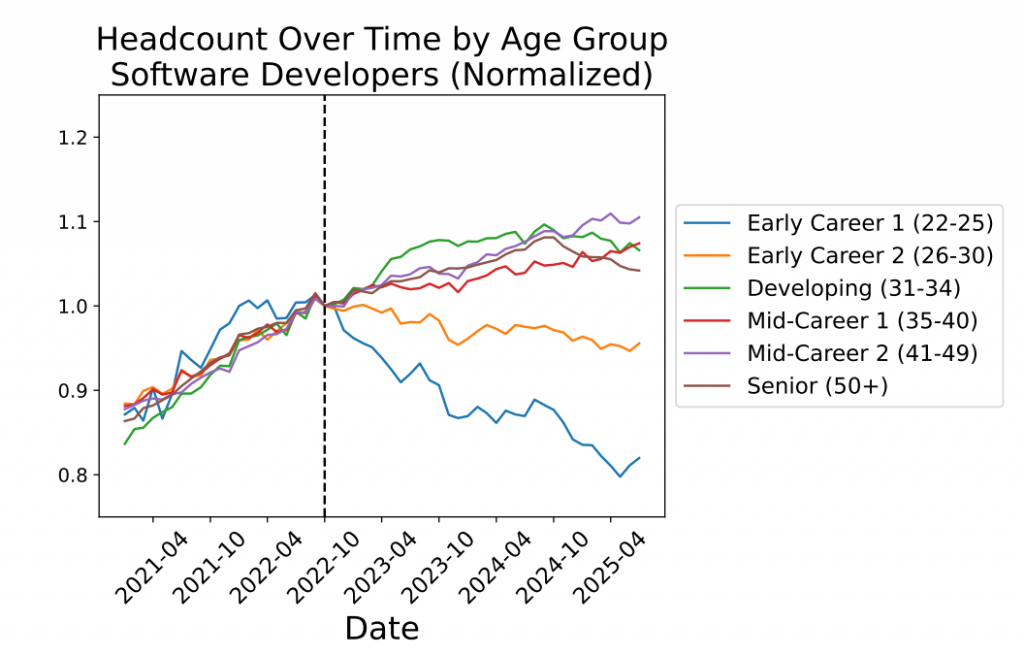
Other “white-collar” professions are also affected, such as marketing or sales managers. Conversely, more manual jobs like caregivers or maintenance workers have not seen any tangible effect.
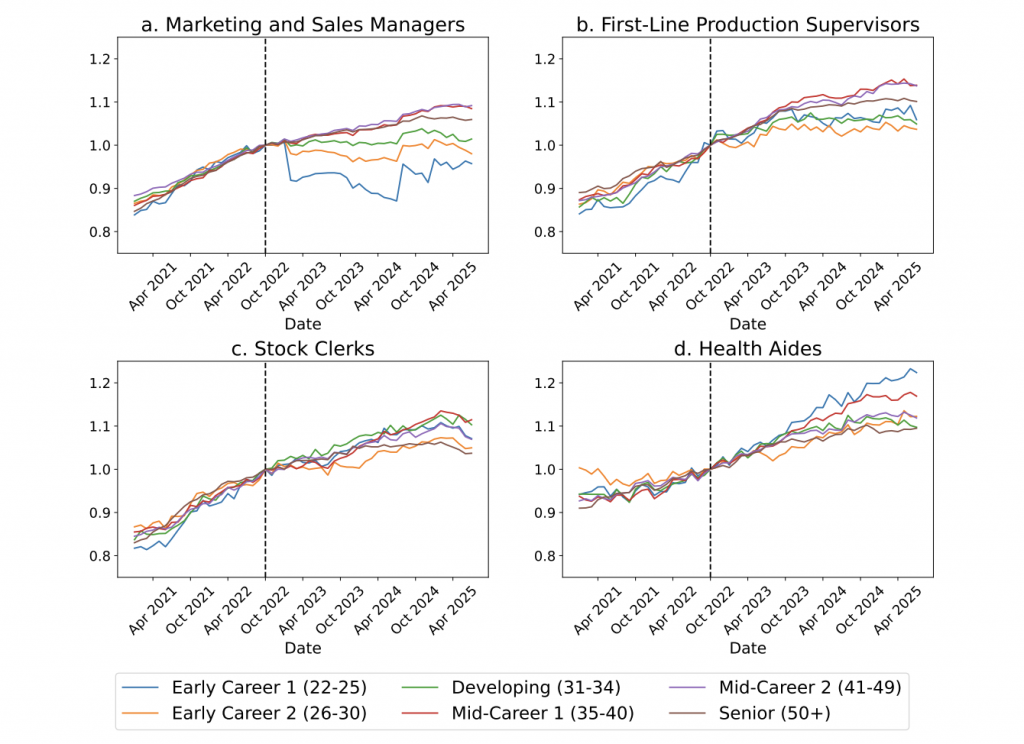
“Our findings are consistent with the hypothesis that AI has this effect on the job market, particularly for entry-level workers,” explains co-author Bharat Chandar.
No Impact for More Experienced Workers
However, the outlook isn’t gloomy for everyone. According to the study, older workers have an employment rate that is maintained or even increases, even in areas highly exposed to AI. Possible explanations? These employees may have skills that AI struggles to replicate. Or they are in hierarchically more difficult positions to eliminate.
Another reassuring piece of news: when AI is used to augment human capabilities – rather than to automate their tasks, the employment rate tends to grow nonetheless.
How to Progress Without Being Able to Start Working?
The other study, signed by Harvard researchers, reaches the same conclusion. It analyzed more distant data, going back to 2015. Result: from 2015 to mid-2022, junior and senior employment progressed steadily. But starting in 2022, junior employment began to stagnate then decline!
Here again, the authors saw no effect for more experienced positions. Reason cited: early-career tasks are easily automatable by artificial intelligence. This, however, raises the question of the erosion of hierarchical levels. If new graduates can no longer get their chance at the beginning of their career, how can they hope to progress later?
“If AI disproportionately affects junior positions, this could have lasting consequences on university salary scales, upward mobility, and income disparities,” the researchers warn.
In France, employment figures also tend to corroborate this impression: 80% of graduates from grandes écoles had found employment at the end of their studies in 2024… compared to 86% a year earlier.
These are weak signals that should be viewed alongside announcements from Accenture, for example, which announced the elimination of 12,000 positions, mainly in the United States, for employees overtaken by AI. Or software giant Salesforce, which will not hire new developers this year due to increased productivity thanks to AI.
Its founder, Marc Benioff, stated last February:
“We are the last generation of leaders to manage only humans. I think every CEO in the future will manage both humans and AI agents.”
 training.isarta.com
  training.isarta.com
  training.isarta.com
  training.isarta.com