
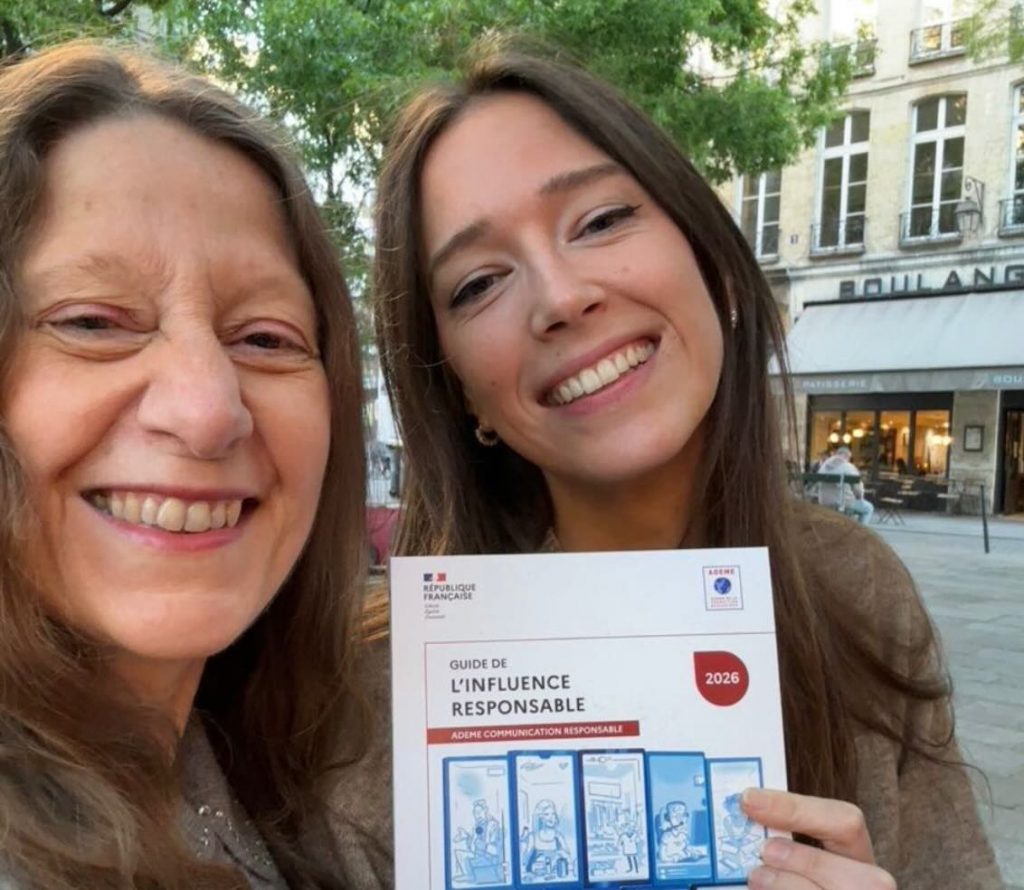
France’s Agency for Ecological Transition (ADEME) published a free guide on responsible influencer marketing last April. It offers a valuable toolkit not only for French creators and brands, but also for those elsewhere looking to build more ethical and sustainable commercial partnerships.
In France, 84% of 15- to 24-year-olds follow at least one influencer. That close relationship is still used primarily to promote lifestyles that are difficult to reconcile with planetary boundaries.
The Guide to Responsible Influence, co-authored by Valérie Martin, head of ADEME’s Citizen and Media Engagement department, and Amélie Deloche, co-founder of the Paye ton influence collective, starts from this observation before turning, in its final section, to concrete ways of changing course.
“In a rapidly changing world, the influencer industry faces a major challenge: supporting the ecological transition and playing an active role in raising awareness, educating and mobilizing communities around more sustainable practices,” says Amélie Deloche.
Here are some of the guide’s key recommendations.
1. Do Your Homework Before Signing
The first recommended step is to build a profile of the advertiser before agreeing to any partnership.
Who owns the company? What is its legal status and industry? Is it affiliated with a lobbying organization? Has it been involved in past controversies? Which creators has it worked with before?
All of these factors deserve scrutiny. So do the organization’s social and environmental impacts, including those associated with the product’s entire life cycle.
The guide provides a ready-to-send questionnaire that creators can email to brands. It also recommends including a withdrawal clause in contracts in case relevant information has been concealed.
This is far from a theoretical exercise. The guide recalls an experiment conducted by YouTuber Simon Puech, who created a fake dietary supplement containing a known deadly poison. Most of the influencers and several agencies approached as potential partners agreed to the collaboration without checking the product’s ingredients.
The lesson is simple: due diligence matters.
2. Five Red Flags for Greenwashing
The guide breaks down the risk of greenwashing into five areas:
- Data
- Claims
- Visuals
- Storytelling
- Activations
The examples are striking precisely because they seem so ordinary.
In one case, creators were invited to test an electric vehicle on a frozen lake. In another, an influencer combined a beach cleanup with a promotional discount code at a shopping mall.
In both cases, the disconnect between the environmental message and the commercial context is enough to turn an otherwise well-intentioned campaign into greenwashing.
3. From Assessment to Action Plan
The next step is introspection. The guide suggests that creators ask themselves questions such as:
- Which industries account for most of my brand partnerships?
- Have I ever turned down a partnership for ethical reasons?
- Do my posts promote lifestyles with a high environmental footprint?
The guide encourages creators to measure their personal carbon footprint, while agencies are urged to examine their CSR policies and the training provided to their teams.
The transition is deliberately incremental. Suggested actions include:
- Stop documenting every plane trip.
- Avoid promoting micro-trends.
- Take on fewer partnerships, but choose them more carefully.
To make the approach sustainable over the long term, the authors recommend establishing an ethical charter, supported by measurable targets. These could include cutting partnerships with high-impact brands by half, aiming for 50% non-commercial content, producing two pro bono pieces of content per year, and publishing an annual impact report.
The Business Model Remains the Biggest Challenge
There is, however, one fundamental issue that the guide only briefly addresses: the business model itself.
Nearly 90% of creators’ income comes from advertising, Amélie Deloche points out in an interview with SocialRama. She describes responsible influence as a “constant battle” and notes that environmental awareness has clearly taken a step backward in recent years.
Long-haul press trips and fast fashion have returned to influencer partnerships without necessarily triggering controversy.
The toolkit is ready.
Adoption, however, still has a long way to go.