

Is artificial intelligence really replacing entry-level jobs? Many reports seem to validate that hypothesis, backed by data. Yet a study by two researchers at the London School of Economics offers a more nuanced picture — pointing the finger instead at remote work. An analysis.
The moment went viral. On May 15th, speaking to students at the University of Arizona, former Google CEO Eric Schmidt was booed the moment he began talking about artificial intelligence.
“Your generation fears that the future is already written, that machines are taking over, that jobs are disappearing, that the climate is deteriorating, that political life is fractured, and that you are inheriting a mess you didn’t create. I understand that fear,” he improvised, trying to calm the room.
It has to be said that the signals don’t bode well for the new generation preparing to enter the job market. A study published last year by three Stanford University researchers found that since the end of 2022 and the public arrival of ChatGPT, overall employment has seen solid growth… except for early-career workers — and particularly in professions most exposed to AI, such as software development.
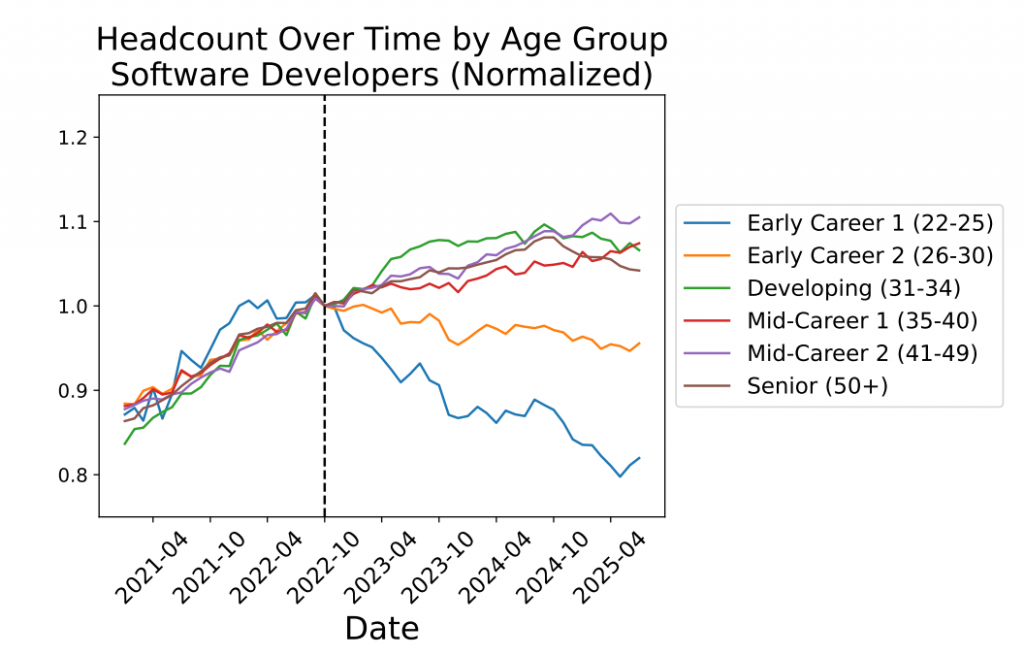
A conclusion echoed even by the leading players in artificial intelligence themselves. Why hire junior staff to handle simple tasks — meeting summaries, market analysis, and the like — when ChatGPT and its peers can do them in no time?
Remote work in the crosshairs
Is AI really responsible for junior workers’ struggles in the job market? Not necessarily, argue two academics at the London School of Economics in a recent study.
“We consider this verdict premature, because exposure to generative AI is strongly correlated with another post-pandemic shock: remote work,” they explain.
In other words, the correlation between AI and declining junior employability may not be a causal relationship. Remote work expanded at roughly the same time and pace — and since working from home tends to affect the same roles and sectors as AI, the two factors can become so intertwined that it’s nearly impossible to tell which one is actually responsible for the outcome.
After meticulous statistical work covering more than 400 million online job postings and 243 million new hires between 2017 and 2025 across the United States, the United Kingdom, Canada, and Australia, the researchers were nonetheless able to let the data speak.
“Our results clearly indicate that exposure to remote work is a stronger predictor of the decline in entry-level hiring,” they conclude.
A tentative explanation: at a distance, it is harder to train and supervise someone new to the workforce, so companies tend to favor more experienced profiles.
It’s obviously difficult to settle the debate on the basis of a single study. But this one at least has the merit of adding some nuance — especially at a time when remote work now appears to be retreating in many organizations, while AI continues its relentless advance.
The study also complements what some HR leaders have been saying, particularly those who have no intention of scaling back junior recruitment.
“If there’s no knowledge transfer tomorrow, there’s no pipeline — and the company’s future is called into question,” noted Véronique Violin, Chief Human Resources Officer at Deloitte France, in the French outlet Les Echos.
A view echoed by her counterpart at KPMG: “Cutting back on those hires would be a strategic mistake.”
The debate remains open.

 training.isarta.com