

They’re supposed to be the generation that stands to benefit most from it — and yet they seem to be pulling away. That’s the surprising takeaway from a recent Gallup report on Gen Z’s relationship with AI. Here’s an attempt to make sense of it.
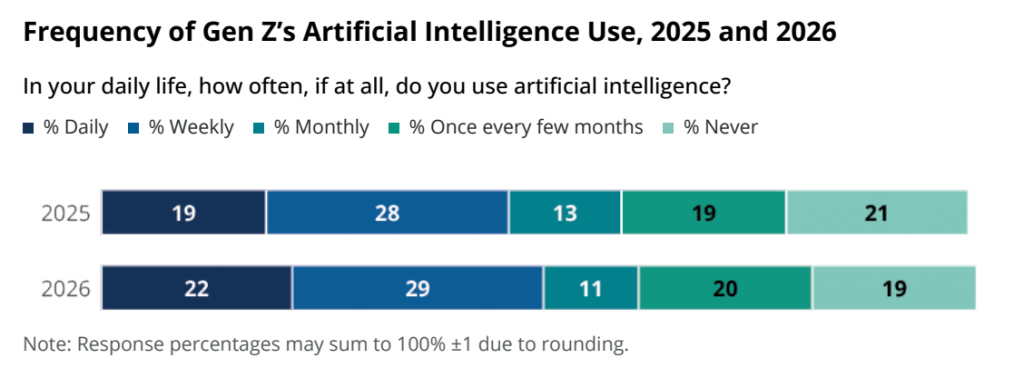
The study, conducted among more than 1,500 young Americans aged 14 to 29 between late February and early March, opens with a finding that cuts against the conventional narrative: generative AI adoption among Gen Z has plateaued. Barely one in two respondents says they use it at least once a week (22% daily, 29% weekly) — virtually unchanged from the previous year.
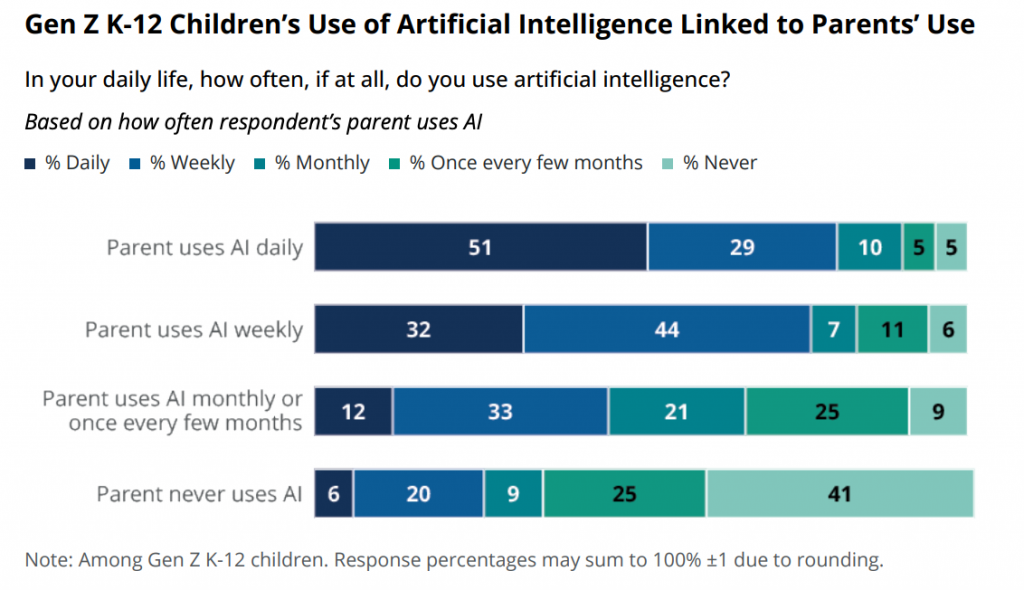
Strikingly, one of the biggest drivers of AI adoption turns out to be… parental influence. 80% of children whose parents use AI daily use it themselves at least weekly, compared to just 26% when parents never use it at all.
A deteriorating perception
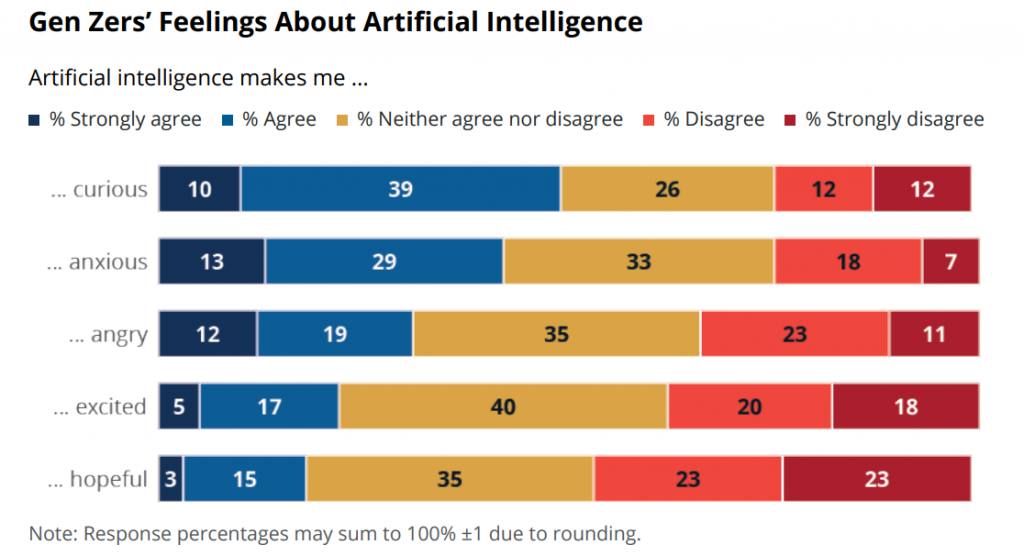
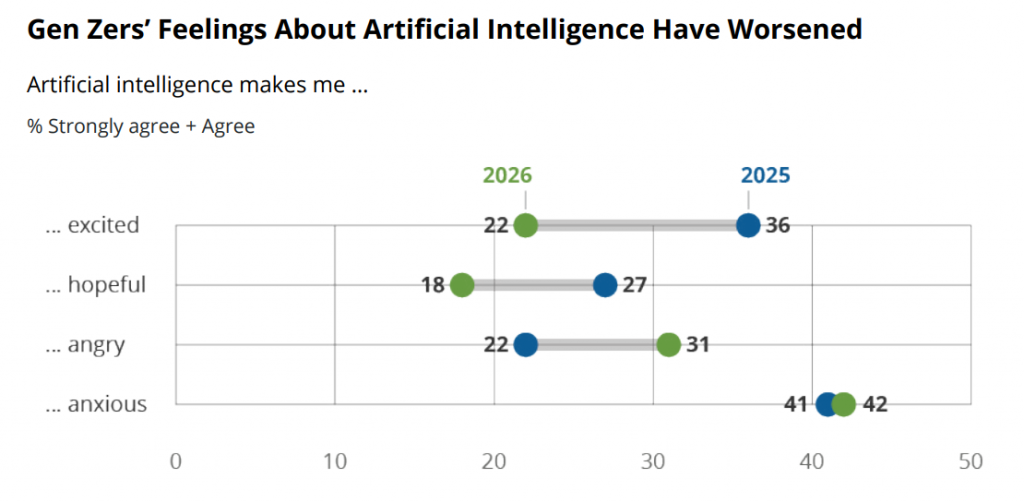
But the study’s main finding concerns how Gen Z feels about AI — and more specifically, how that perception has worsened.
Enthusiasm has dropped 14 points (from 36% to 22%), hope has fallen 9 points (from 27% to 18%), while anger has jumped 9 points to reach 31%. Anxiety holds steady at 42%. Only curiosity (49%) still comes out on top.
Even among the most frequent AI users, who generally hold more positive feelings than lighter users, enthusiasm has collapsed by 18 points and hope by 11. Familiarity, it seems, is no longer enough to generate buy-in.
Doubts about AI’s value at work
How do we explain what the report itself calls a paradox?
“The uncertainty toward AI likely reflects concerns about its perceived impact on learning and workplace performance. Gen Z is not convinced that artificial intelligence will help them find reliable information, generate new ideas, or analyze information rigorously,” Gallup notes.
Indeed, 38% believe AI will hurt their creativity more than it will help. A similar share (42%) say the same about their critical thinking skills. Confidence in productivity gains is also eroding: only 56% now believe AI speeds up their work (down 10 points), and 46% think it accelerates learning (down 7 points).
All told, eight in ten young people consider it “likely” that AI will make future learning harder for them.
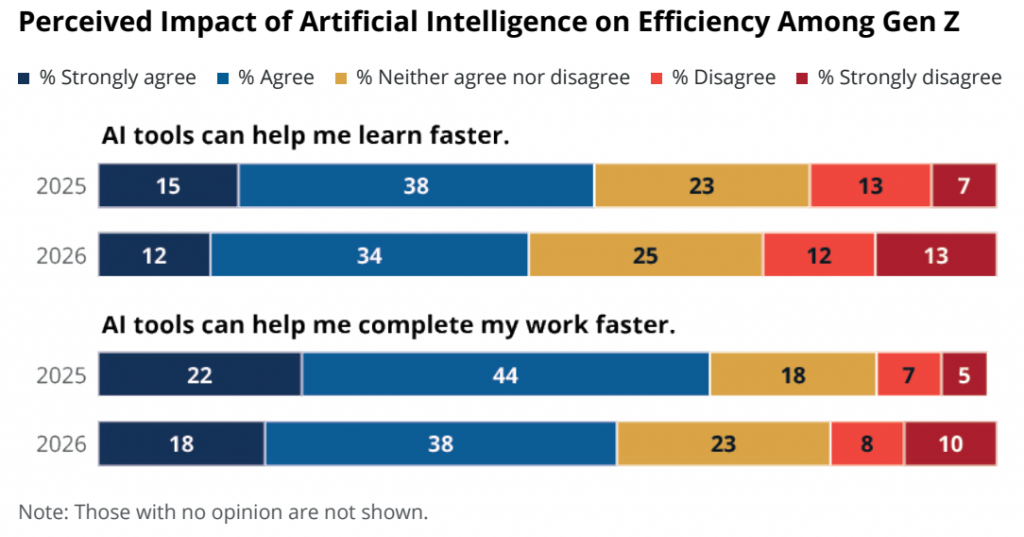
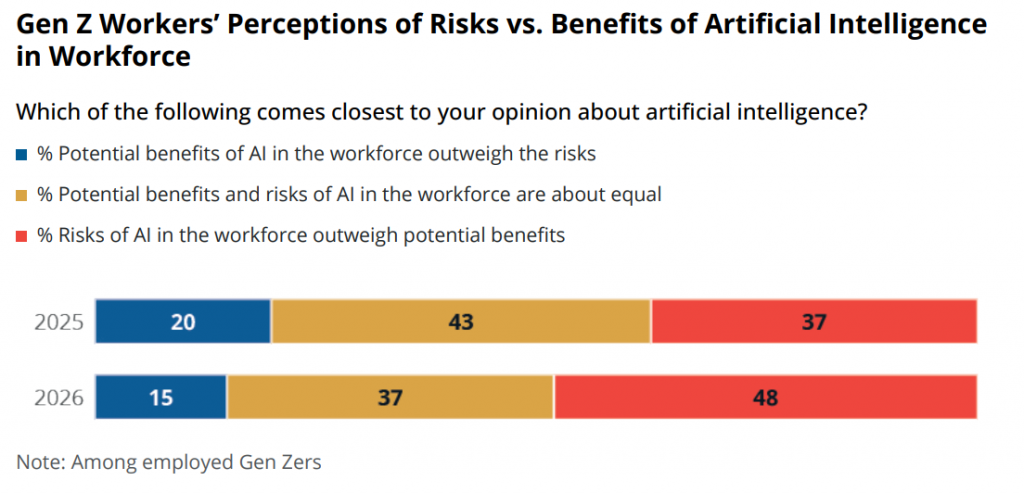
In the professional world, skepticism is tipping into distrust. Among young workers, 48% believe the risks of AI at work outweigh its benefits, versus just 15% who think the opposite — a hard position to argue with, given how difficult it has become for some professions to break into the job market.
AI becoming normalized in schools
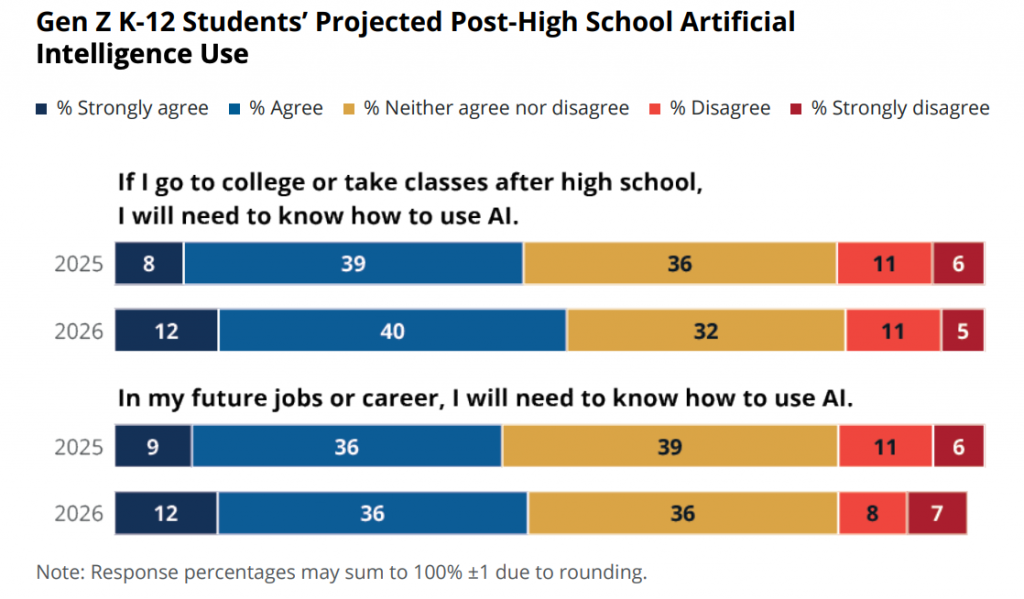
Despite all this, Gen Z remains clear-eyed about the need to master these tools. 52% believe they will need AI skills for higher education (up 5 points), and 56% now feel confident they can acquire those skills before finishing school (up 12 points).
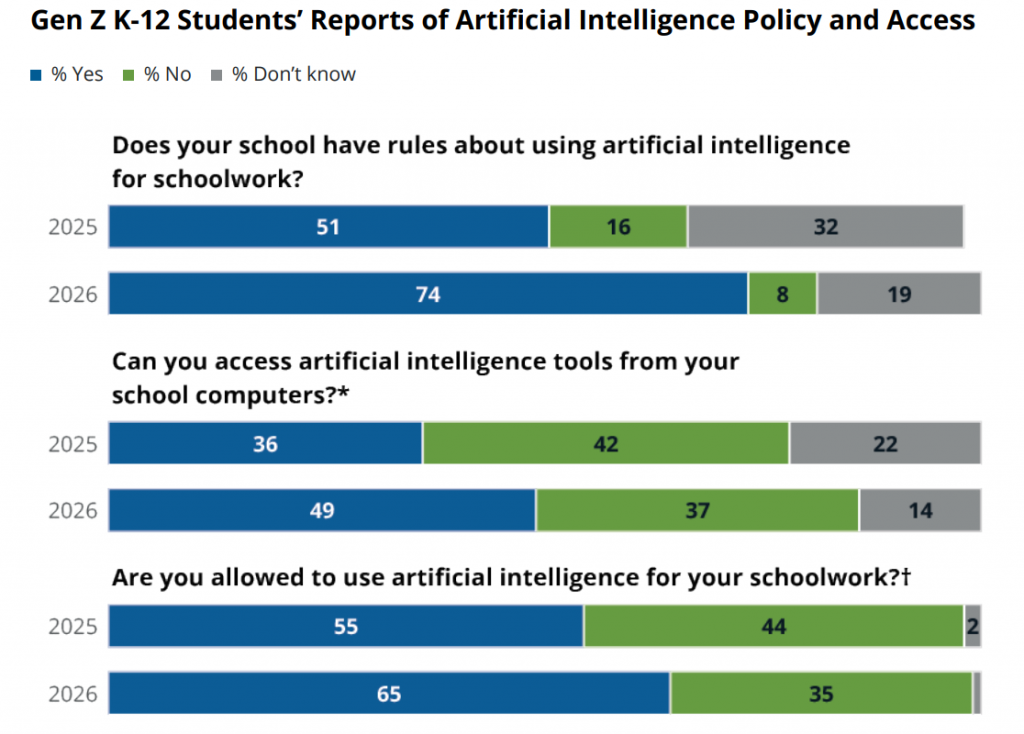
Schools appear to have taken the turn as well: 74% of students report that their schools have rules around AI use, up from 51% a year earlier. And 65% now accept the use of AI for schoolwork, a 10-point increase. Yet another paradox.

 training.isarta.com