
Artificial intelligence is creating very well-paid jobs… most of which go to men. Women, for their part, remain relatively on the margins of this boom, both as professionals in the sector and as users. An analysis of this worrying (but perhaps not definitive?) gender inequality.
More than a million new jobs created in the United States since mid-2023. That is The Economist’s recent estimate, with salaries well above average. According to LinkedIn, AI-related job postings have nearly doubled since 2023, with an advertised salary of nearly $177,000, compared with $80,000 for jobs not related to AI.
The problem, according to that same study, conducted in 27 countries: women accounted for only 26% of AI hires in 2025, compared with 50% in other occupations.
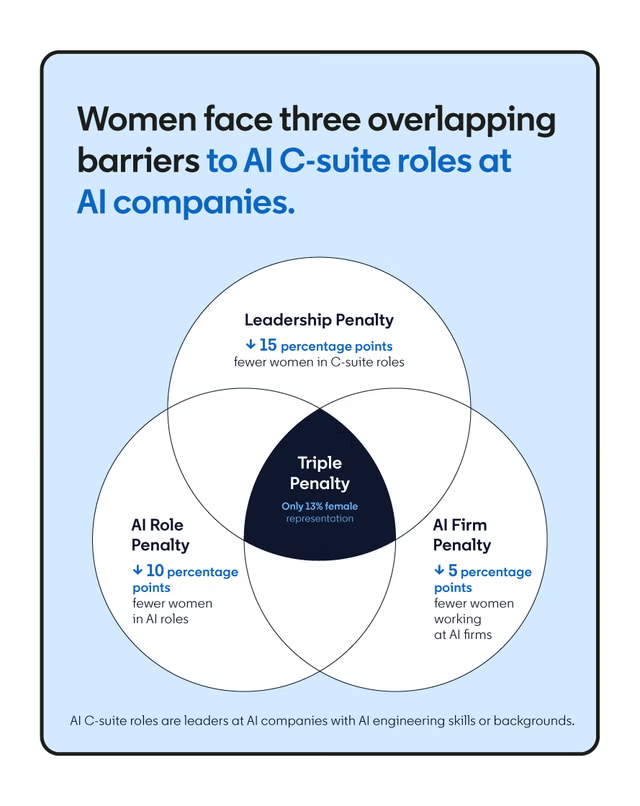
The economists at the professional social network speak of a “triple penalty”:
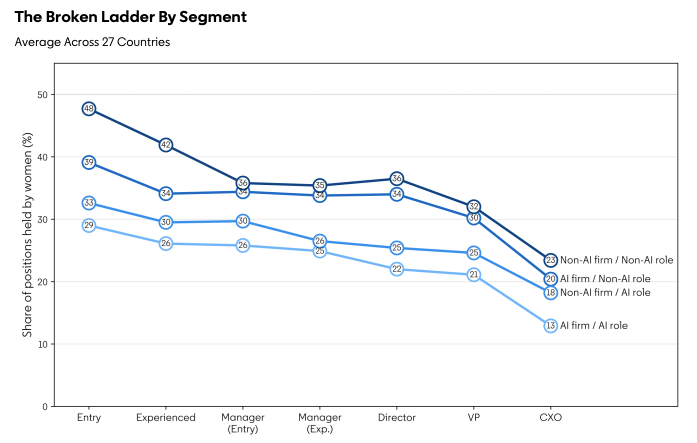
- The leadership penalty. They are almost absent from the leadership of AI companies: 13% of executive positions, compared with 23% on average. The sector’s champions are almost all led by men.
- The role penalty. They are a minority in AI functions: 29% of entry-level staff, compared with 48% across all sectors. Above all, they mostly hold the least-skilled jobs (50% of support functions, for example). Conversely, 82% of “forward deployed engineers,” one of the most sought-after profiles at the moment, are men.
- The AI company penalty. The proportion of women among employees of companies specializing in AI is about 5 percentage points lower than in companies that do not specialize in AI.
Women’s representation declines at each step toward AI leadership
Less frequent use as well
The gender gap is not only found in careers. According to a survey published by Harvard researchers last year, women use generative AI nearly 25% less than men.
“Contrary to what one might think, this lag has nothing to do with a lack of skills or interest,” says Niki Hubaut, France director at Confluent, in this op-ed. “In tech companies, what we observe is mostly a difference in posture toward risk. Many women hesitate to use AI for fear of appearing unprofessional (less rigour, less expertise, less added value), or of their colleagues thinking they are ‘taking shortcuts.’ Where some see a tool for acceleration, others see a possible challenge to their legitimacy.”
With the already existing risk that the systems end up reflecting dominant male viewpoints and only reinforce these biases. According to the report The Future is Fem[AI]le, 88% of AI algorithms are indeed developed by men. While 73% of leaders consider it important to have more women on these topics, only… 33% have a woman at the helm of strategic decisions!
Time to act?
In a conference last year covered by BDM, Leïla Grison, managing director of the Women’s Forum, chose to remain optimistic: AI can speed up the reduction of inequalities.
For example, by offering new job opportunities, by easing career changes, by helping break the glass ceiling through better opportunities for training, or by reducing the burden of the “double shift” (at the office and at home).
“If we don’t change how we look at AI, we are going to ban our children from using this technology. And banning their access to AI because we think that using it is cheating means cutting them off from success in a world that, tomorrow, will require mastering AI to get hired, more than hard skills,” she says.
For Niki Hubaut, “the gender gap narrows sharply in organizations where leaders explicitly encourage experimentation and normalize imperfect use of AI.”
Which raises the question of the corporate culture and climate of trust established to make AI adoption easier.
“The good news is that the norms around AI use are still being built. I am convinced that we now have a real opportunity to correct the course, by steering the narrative toward inclusion rather than exclusion,” concludes Niki Hubaut.

 training.isarta.com