
A recent Gallup study shows marked concern in Western countries about the rise of artificial intelligence. Attempts at an explanation.
A few months ago, we discussed on Isarta a double paradox about AI. On the one hand, in terms of productivity, with employees who see their performance rise but companies that struggle to draw concrete benefits from it on a larger scale.
On the other hand, in terms of trust, with Generation Z being the group that uses it the most… but also the one that feels the most negative about it.
The global study (37 countries) released by polling firm Gallup last September adds another piece to the puzzle of this ambivalence.
First finding: use has grown massively in the most advanced countries. Thus, 47% of Canadians aged 15 and over use artificial intelligence tools at least once a week, and nearly a third (29%) use them every day. That places the country in the top 10 in the world for use, behind Singapore (62%) and China (61%) but ahead of the United Kingdom and the United States.
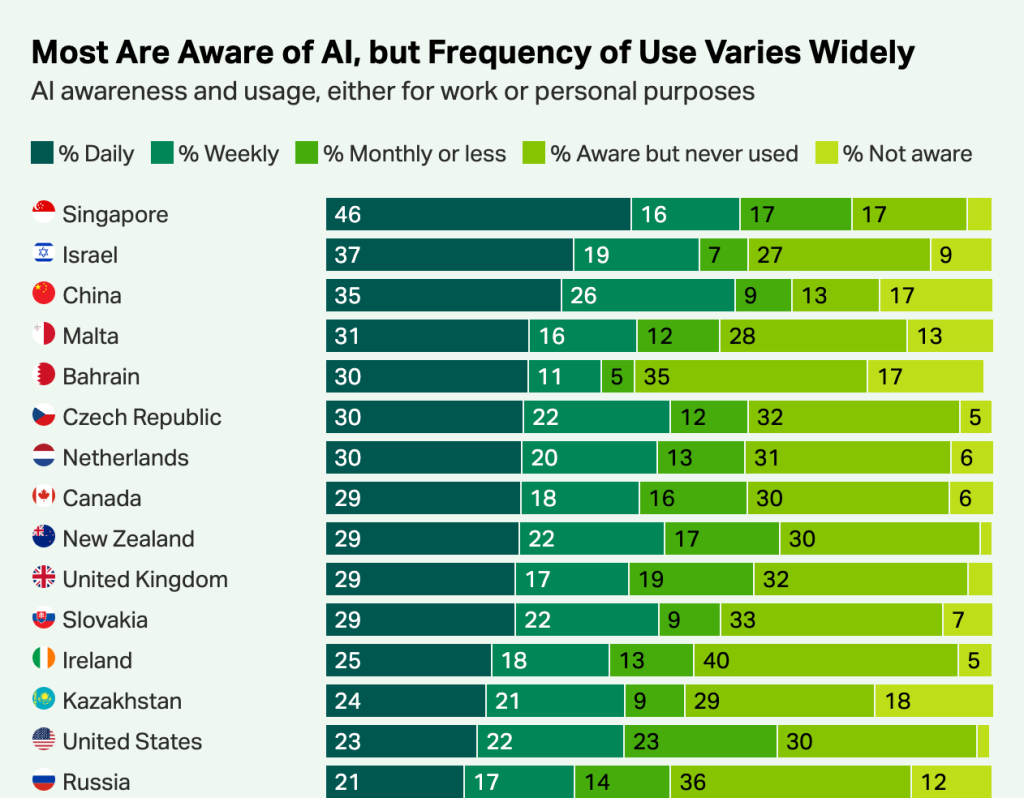
Overall, Gallup notes that in 34 of 37 countries, positive emotions remain dominant (a median of 72% positive feelings versus 41% negative). Curiosity comes first (64%), while overall worry stands at 32%.
The “Western” paradox? In the Western countries where use is highest, the level of worry… also reaches record highs! In the United States, the leading country on the subject for now, 74% of respondents say they are worried about AI.
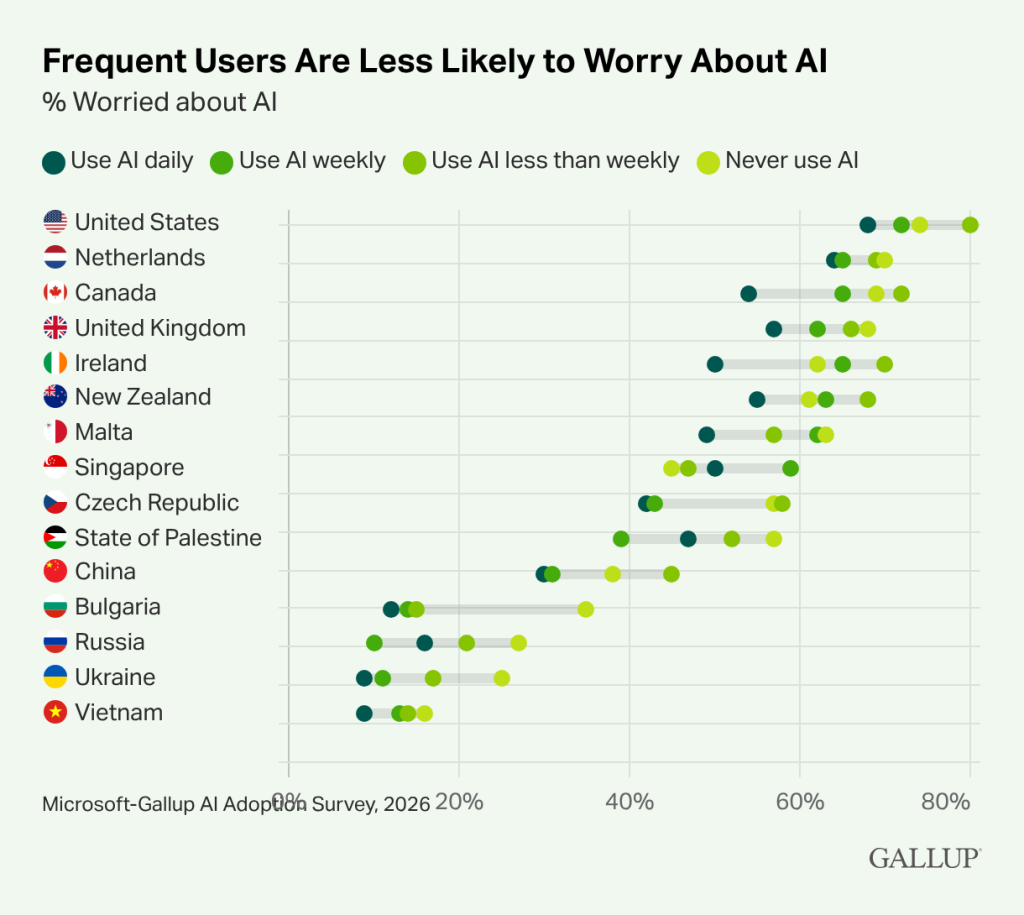
Canada, the Netherlands and the United Kingdom are not far behind. Admittedly, the most active users are the least worried… but they remain, for the most part, worried all the same!
It is obviously difficult to isolate one particular reason for this Western mistrust. Let us nonetheless try to offer a few leads by looking at other studies on the subject.
A real gain at work?
The first is the work of technology services firm Adaptavist, which conducted a survey last May of 2,500 knowledge workers in five countries (United States, Canada, Germany, United Kingdom, Spain). Its title? Understanding the human cost of AI transformation.
The main lesson: instead of lightening the workload, AI actually just redistributes it! A telling figure backs this up: 42% of respondents spend more time checking AI’s output than they gain from using it. In the crosshairs is the now-famous AI slop, which we already discussed last October: AI-generated professional content that gives the impression of being good work but actually lacks the substance to prove truly useful.
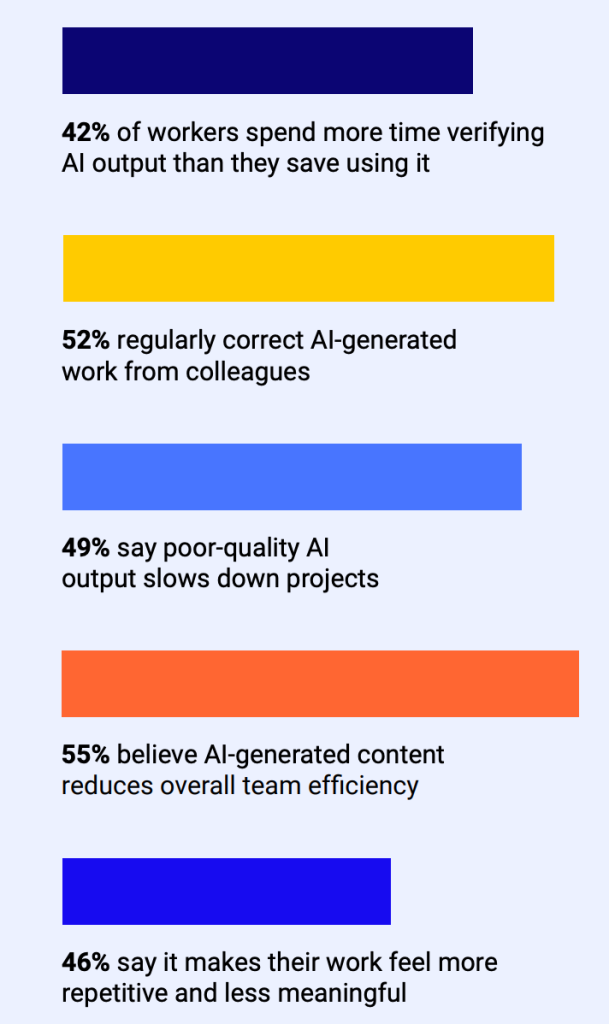
The result: nearly two-thirds (65%) of respondents regularly feel nostalgic for the way work functioned before AI became widespread.
More specifically, nearly half (46%) are frustrated to see that tasks requiring years of expertise can now be done by almost anyone thanks to AI.
A consequence already visible in young people’s jobs
The other study comes from the Banque de France, which analyzed the first changes in the labour market for young people with the rise of generative AI. The finding is alarming: hiring of 21- to 29-year-olds is in free fall (down 28.3% for the most exposed occupations) since the arrival of ChatGPT almost four years ago.
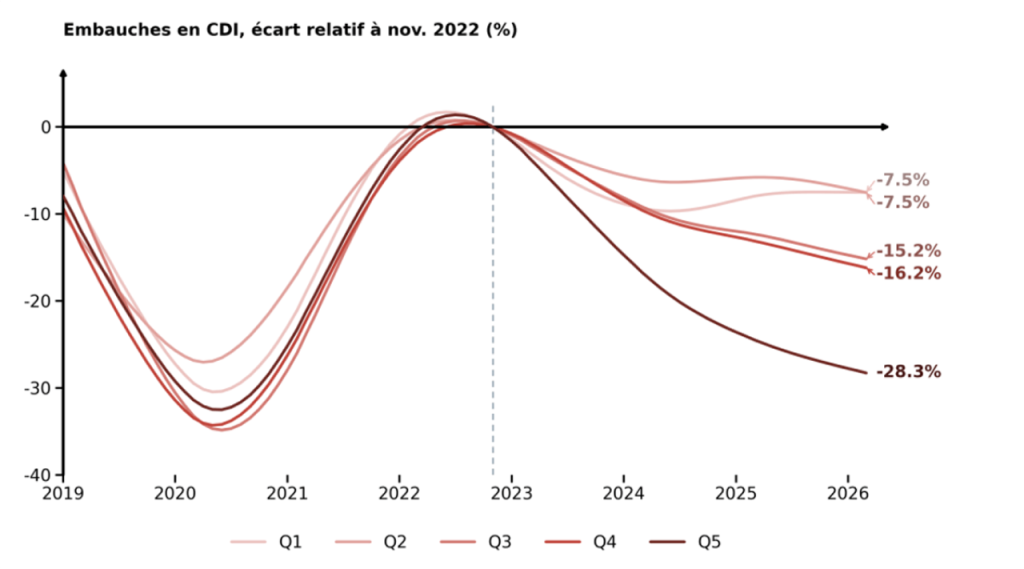
The study’s authors are nonetheless cautious, since the period also coincided with “monetary tightening, the post-Covid correction in the tech sector and the growth of remote work,” which may also have a negative impact on the hiring of juniors.
Still, this signal comes on top of others. Take this survey by France’s Association nationale des DRH (ANDRH, the national association of HR directors), which indicates that 10% of employers have already cut back on junior hiring in the face of the rise of AI.
Enough, indeed, to justify the prevailing anxiety.

 training.isarta.com