
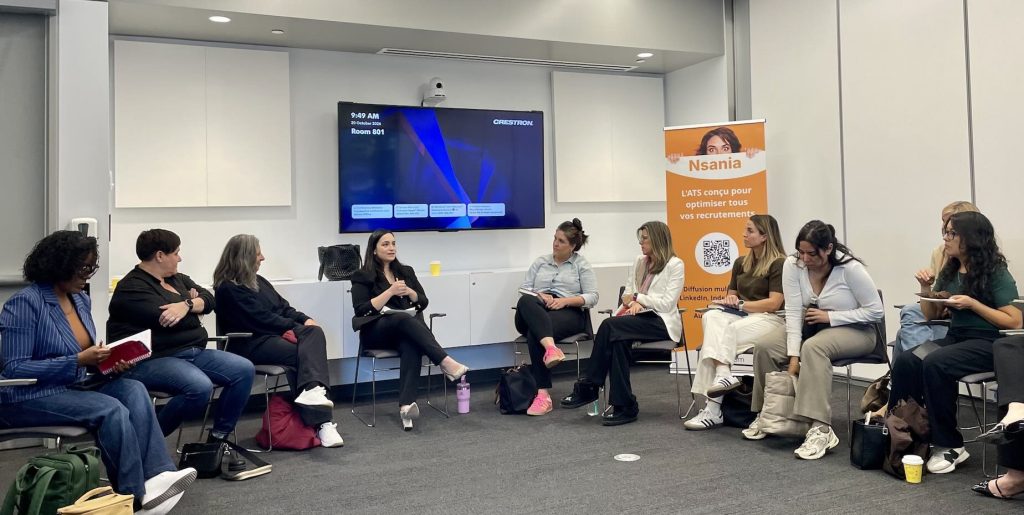
The 14th edition of TruMontréal, the recruitment “non-conference” was held this Tuesday, October 20, in Montreal. It was a chance to take the pulse of recruiters on hot topics such as neurodiversity and the economic slowdown, but also, and above all, the impact of AI on recruitment. A look back at the event, kept going through the sheer determination of Sandrine Théard, founder of the recruitment school Les Sources Humaines.
In the small conference room, with a partly obstructed view of Mount Royal, it was a great opportunity, coffee and muffin in hand, to ask recruiters what they had come looking for at this event. The answer was always the same: they wanted to talk about, and hear about, artificial intelligence! Notably the impact of AI on the profession, understanding the risks and, ultimately, knowing what to do with it.
“I don’t feel like I’m saving time, just that my brain works differently,” explained one participant during the discussion “From Recruiter to Talent Architect: AI Sources, Screens, Books the Meetings… Where Do I Fit In?” “I have to challenge candidates a lot more, because they’re using AI too. We have to go back to in-person interviews, which is a logistical thing to manage.”
Growing vigilance against fraud
AI is indeed affecting the entire recruitment chain, including candidates. Many recruiters pointed out that several of the résumés they receive do not match the candidate’s real skills. This leads to situations that are sometimes comical or absurd.
Take the talent acquisition lead who received an application from a certain “Jean-François Gatti” who had studied at Polytechnique. On a video call, the recruiter was confronted with a candidate of Asian origin, speaking English with a strong Asian accent. When she asked to switch to French, the candidate disconnected… and vanished without a trace!
Sourcinc founder Sébastien Savard, for his part, was asked by his American clients how his firm ensures that “sourced” applicants are real people and not avatars or fraudsters.
“One type of fraud we see a lot of in the United States is people applying for several remote jobs. They can hold four or five positions at the same time, which they run with artificial intelligence,” he explains.
Mistrust has reached the point where some employers don’t want to meet candidates whose résumé looks “too perfect,” because it was made with AI, says one recruiter.
“Wait a minute… can we talk to the candidate first? Can we see what they will tell us in an interview rather than relying only on the résumé?” she wonders.
Portrait of a recruiter armed with AI
Of course, it’s not only candidates who use AI. Recruiters do too. Sometimes they do so without even worrying about ethics or the laws in force, as reported by one recruiting director, who realized that members of her team were taking applications submitted in an ATS and dumping them into ChatGPT to get a quick evaluation.
“Candidates did not consent to this use of their information,” she protested.
Other recruiters didn’t seem to see a problem with this practice, arguing that the “shadow” use of AI was understandable in such a fast, competitive market.
The Sourcinc team, for its part, tested the Alex AI app, an agent that conducts interviews according to the approach the recruiter requests.
“The results are impressive,” says Sébastien Savard. “The agent asks questions as relevant as a good recruiter, but perhaps not as relevant as an excellent recruiter. The problem is that candidates really don’t like it.”
“Recruiters continue to play an important role, but more in the evaluation of candidates”
It is clear that the recruitment market is undergoing profound changes. In her welcome remarks, Sandrine Théard herself said she was thinking about her future. Partly as a joke, partly as provocation, she admits. But she nonetheless notes that a portion of the recruitment value chain is on its way to being siphoned off by AI.
“The candidate search and profile identification part is increasingly being taken over by AI. Sourcing agencies are closing; there are a lot of questions on that side. Recruiters continue to play an important role, but more in the evaluation of candidates.”
The founder of TruMontréal tempers her remarks by recalling that 20 years ago, LinkedIn greatly disrupted the practice of recruitment. The end of the recruiter’s profession was announced at the time, since everyone could now put themselves on LinkedIn.
Yet none of that happened. In a professional world shaped by LinkedIn, recruiters have never been in such demand. What remains to be seen is what place recruiters can occupy, with an AI that boosts their performance at full speed.

 training.isarta.com