
For the first time, social media and video platforms have overtaken television and news websites as the leading source of news. That is one of the key findings of the 15th edition of the report from the Reuters Institute for the Study of Journalism (RISJ), a media research centre affiliated with the University of Oxford. Highlights.
News now plays out on platforms. According to the Reuters Institute’s 2026 Digital News Report, based on a survey of nearly 100,000 people in 48 countries, social and video networks are now the most widely used source of news in the world, accounting for 54% of audiences.
This milestone has less to do with a surge in the use of this channel, which has hovered at this level for about a decade, than with the steady, gradual erosion of television (down from 75% to 52% in 10 years) and news websites (from 68% to 51%).
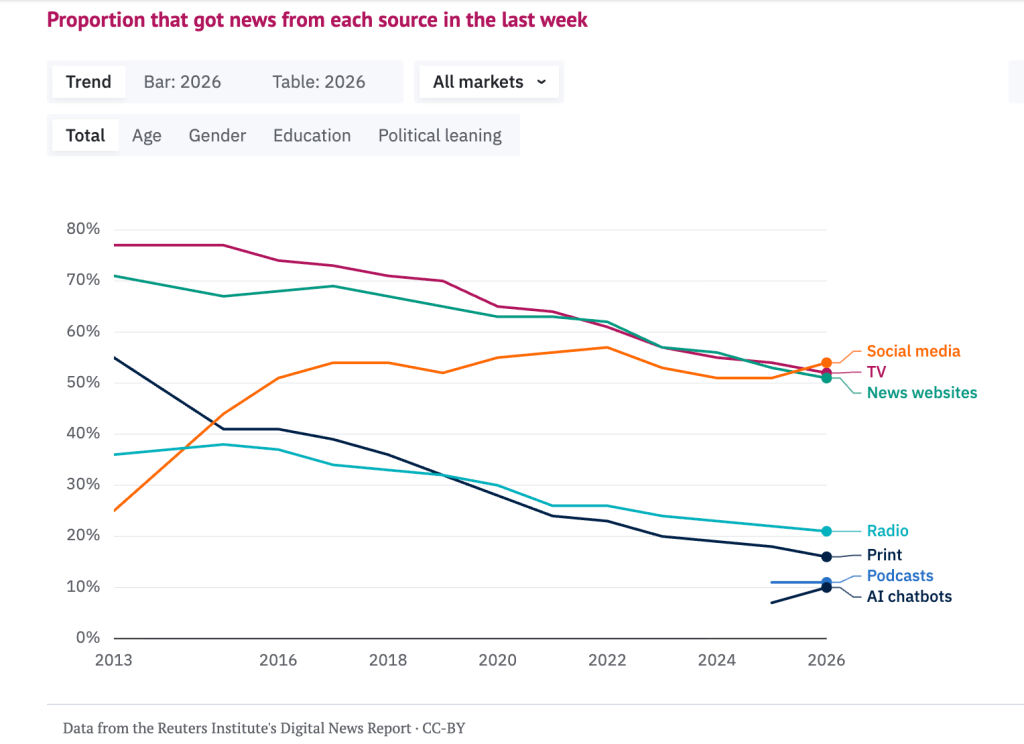
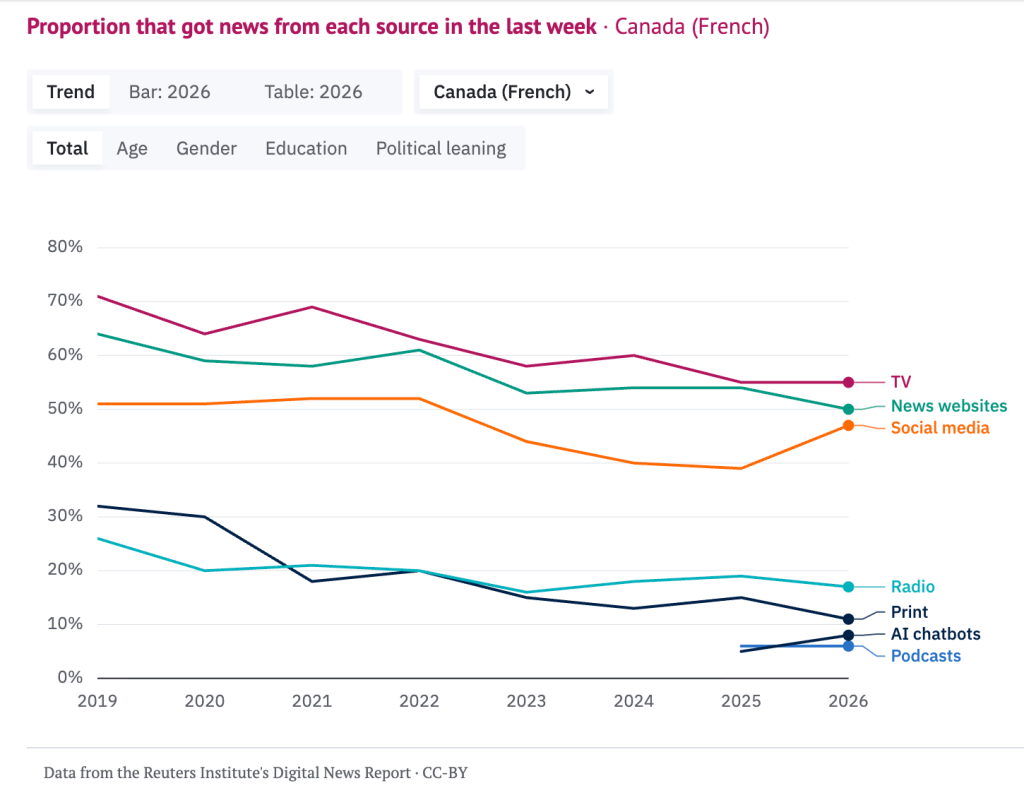
Note that this upheaval has not yet taken place in French-speaking Canada (though it is, conversely, more pronounced in English-speaking Canada).
The consequence for communicators is direct: the public no longer comes to you. It is up to you to go and find it where it is!
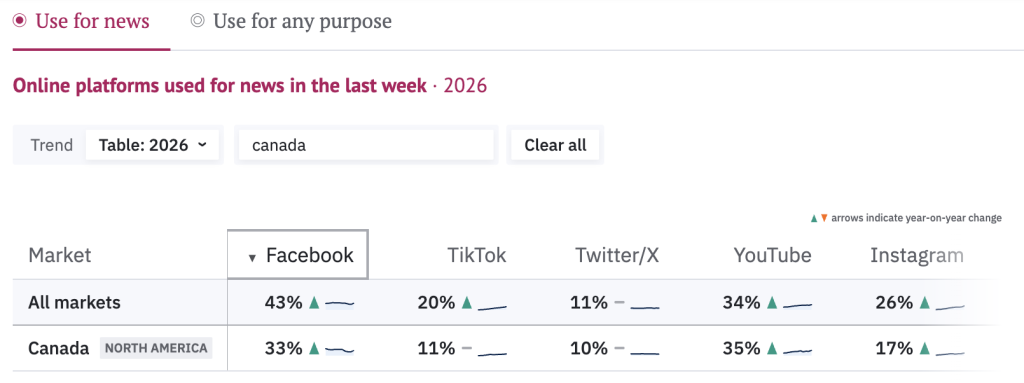
In Canada, YouTube (35%), Facebook (33%) and Instagram (17%) are the most consulted sources for news.
Video becomes the default format
Across the 48 markets studied, a majority of people now watch online news video: 77% of the global audience every week. In 45 markets, its audience even surpasses that of the TV newscast. Short, personality-driven, mobile-first content is becoming an industry standard.
The rise of creators and influencers is also reshaping the tone and accessibility of news. It remains a marginal phenomenon, however: only 3% of respondents get their news solely through them, and 87% feel they cover only part of their needs, or none at all.
Another takeaway: weekly use of conversational bots such as ChatGPT to get news has risen from 7% to 10% in a year (16% among those under 35). Above all, these users click through to the original sources far less often than those who run a Google search. This points directly to the challenge of GEO, organic visibility on this new, emerging channel, for marketers who want to appear in generated answers.
Trust at an all-time low
Trust in news has fallen to 37%, its lowest level since measurement began. It has dropped markedly in 29 of the 48 markets.
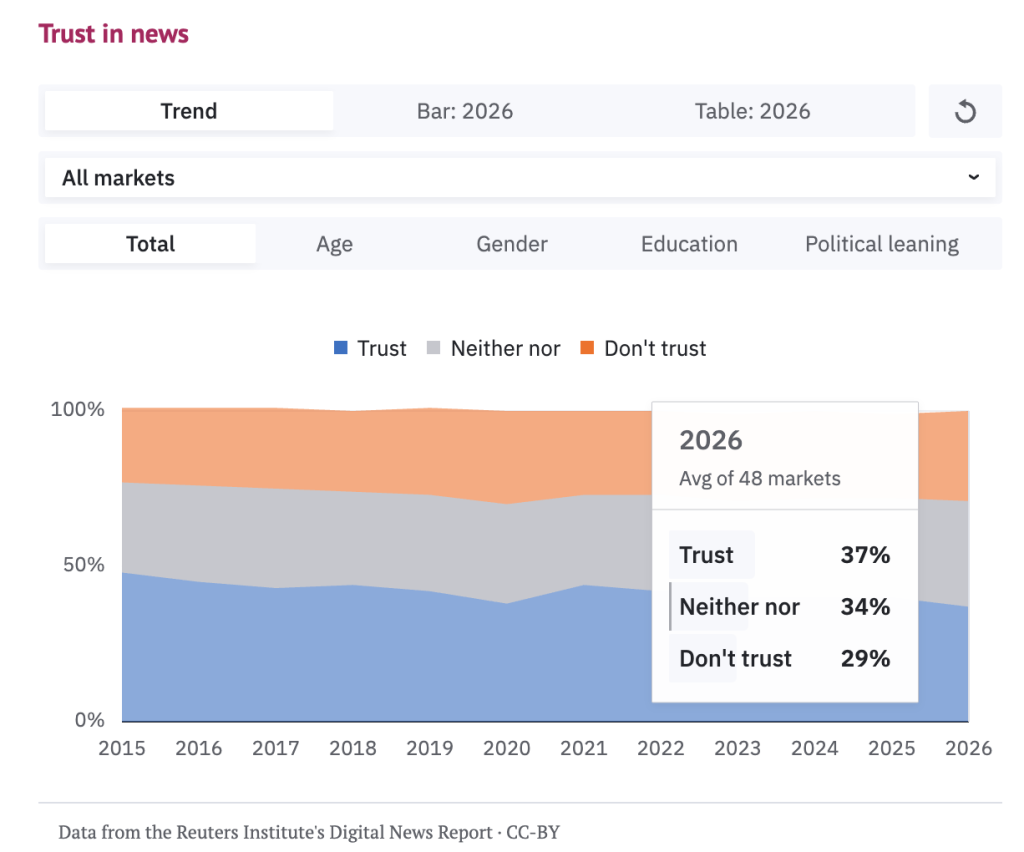
At the same time, concern about false information is up 4 points, to 62%.
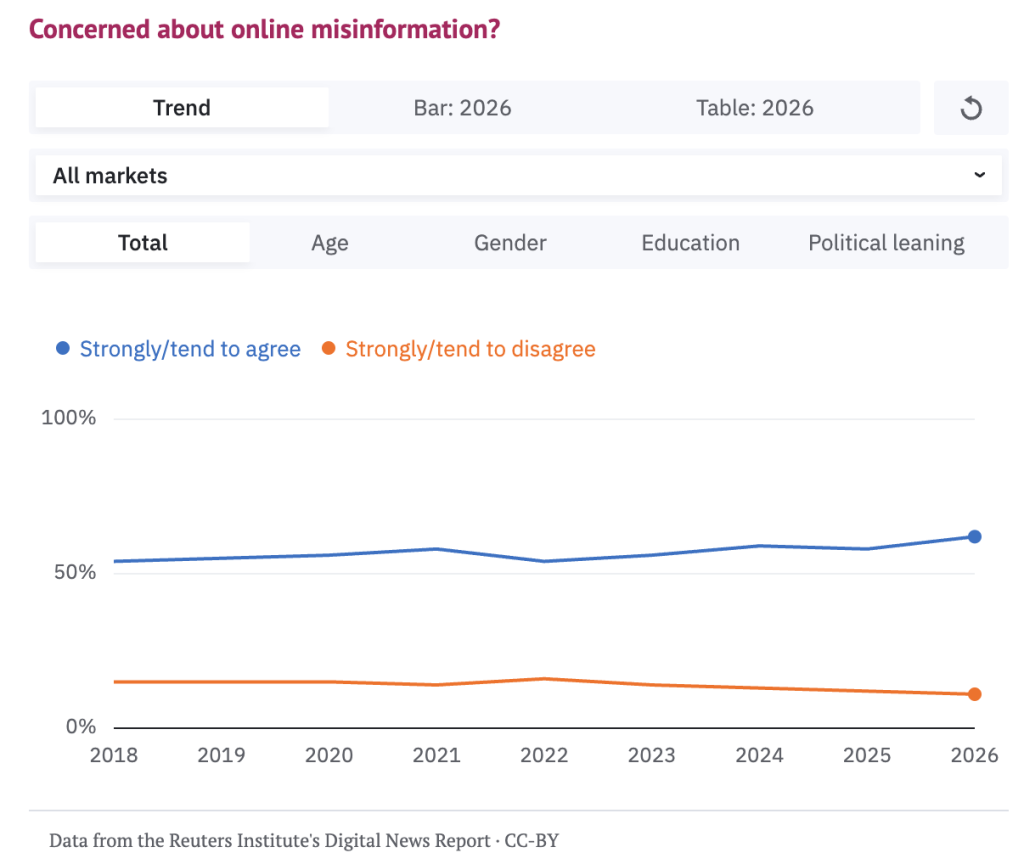
Note that trust erodes differently depending on the channel: 32% trust news from search engines, 22% from social media and 20% from chatbots. In other words, platforms capture the audience, if not the credibility.
What communicators can take from this
Three avenues emerge. First, think distribution before production: content that does not exist on the platforms where the audience is will be less likely to be seen.
Next, bet on video and recognizable faces, without giving up rigour.
Finally, make trust a strategic asset: source transparency, a clear byline and editorial consistency are becoming differentiators in a saturated landscape.
The report sums it up itself: responding to the development of generative AI is the greatest challenge for media leaders and policymakers. It now is, too, for those who need to make a brand heard in this ecosystem.